A thoughtful answer takes a little time, usually under 30 seconds.
Or search with one of these
Rather talk it through? Call 1-888-233-5563
Electric Tuggers
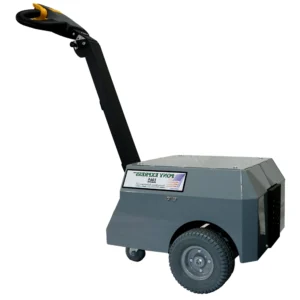
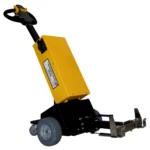
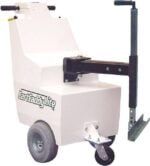
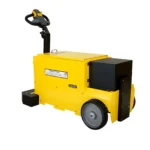
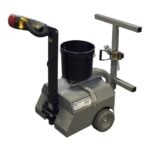
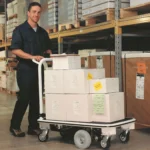
Electric tuggers move heavy wheeled carts and trailers without manual pushing or pulling. A tugger machine is a walk-behind cart mover built for warehouses, hospitals, hotel laundries, mailrooms, and manufacturing floors. Unlike a forklift, a tugger does not lift loads. It tows them horizontally on casters or, in heavy industrial applications, on rails.
HDM specializes in walk-behind (pedestrian-operated) electric tuggers from the US-built Pony Express line by EK Tech. Pull capacities span 1,500 lb compact units for clinic linen and mailroom rounds, 5,000 to 7,500 lb medium-duty models for warehouse and aerospace work, and the AC Tugger that handles 25,000 lb on casters and up to 100,000 lb on rail-mounted loads. Prices run from $4,752 to $20,195.
If your operation needs ride-on tow tractors for long-distance multi-cart trains, MasterMover or a Crown forklift-style tugger is a better fit and we will tell you so. For walk-behind cart moving in tight aisles, hospital corridors, and indoor environments under 65 dBA, this is the deepest catalog HDM offers, with a 21-day manufacturer demo program and a 2-year frame-and-drive warranty.
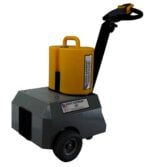
2000 lbs on flat surfaceWeight Capacity30° de-rated load capacityIncline35 Ah, AGM Deep CycleBatteryUp to 3 mphSpeed Range8 hours of operationRangeElectromagneticBrakes
2-year warranty on the frame and motorAuthorized Dealer
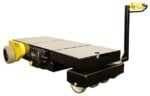
5000 lbs on flat surfaceWeight Capacity30° de-rated load capacityInclineUp to 3 mphSpeed Range8 hours of operationRangeElectromagneticBrakes0° C to +40° COperating Temp
2-year warranty on the frame and motorAuthorized Dealer
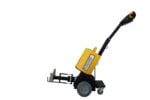
2000 lbs on flat surfaceWeight Capacity39" to 54" adjustableLength24.5"WidthUp to 3 mphSpeed Range40 Ah Lithium Iron phosphateBatteryApproximately 3 hoursCharge Time
2-year warranty on the frame and motorAuthorized Dealer
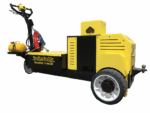
Up to 3 mphSpeed Range8 hours of operationRange120/240 VAC 50/60 Hz UL/cUL CE listed on board smart charging systemChargerAutomatic holding brake prevents cart moving on inclines when parkedBrakesWelded steel powder coated finishFramePuncture Proof Non-markingWheel Size
2-year warranty on the frame and motorAuthorized Dealer
An electric tugger is a battery-powered walk-behind machine that tows wheeled loads. The operator stands or walks behind it, grips an ergonomic handle, and uses thumb-wheel controls to move carts, trailers, gas cylinders, linen bins, or any rolling equipment. Tuggers are not forklifts. Forklifts lift; tuggers tow. They are also distinct from pallet trucks, which lift pallets, and from tugger lifts (a forklift type rated for pit work). If a load already rolls, a tugger can move it. If it sits on a static pallet, you need a pallet truck or forklift instead.
Electric tuggers are also called cart movers, tow tractors, motorized cart movers, powered tugs, and industrial tugs. The terminology depends on the industry. Healthcare buyers say “linen tugger” or “cart mover”. Aerospace and automotive buyers say “tow tractor”. OSHA documentation classifies them under powered industrial trucks (more on that below).
Capacity tiers and how to size yours
Compact (1,500 to 2,000 lb pull)
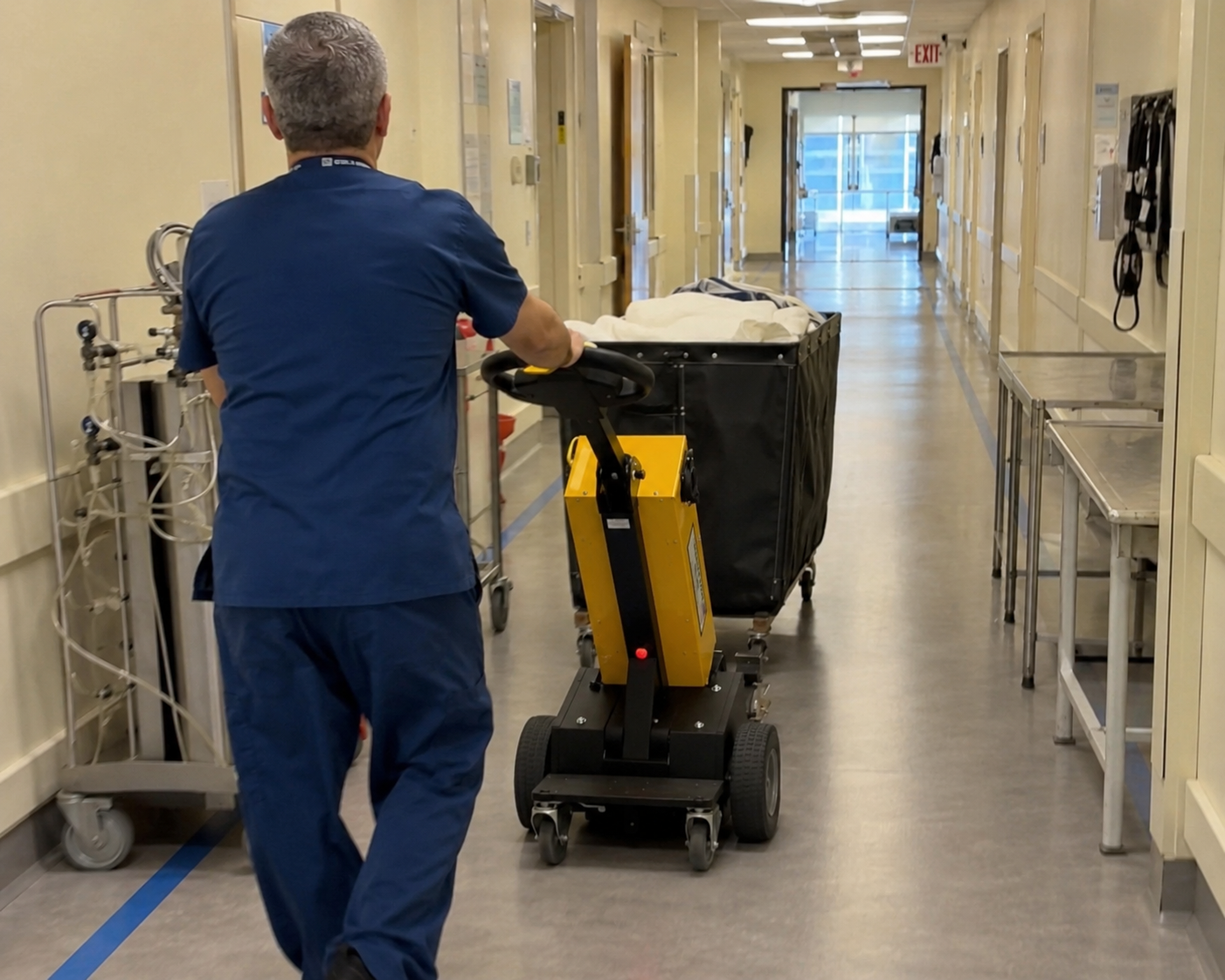
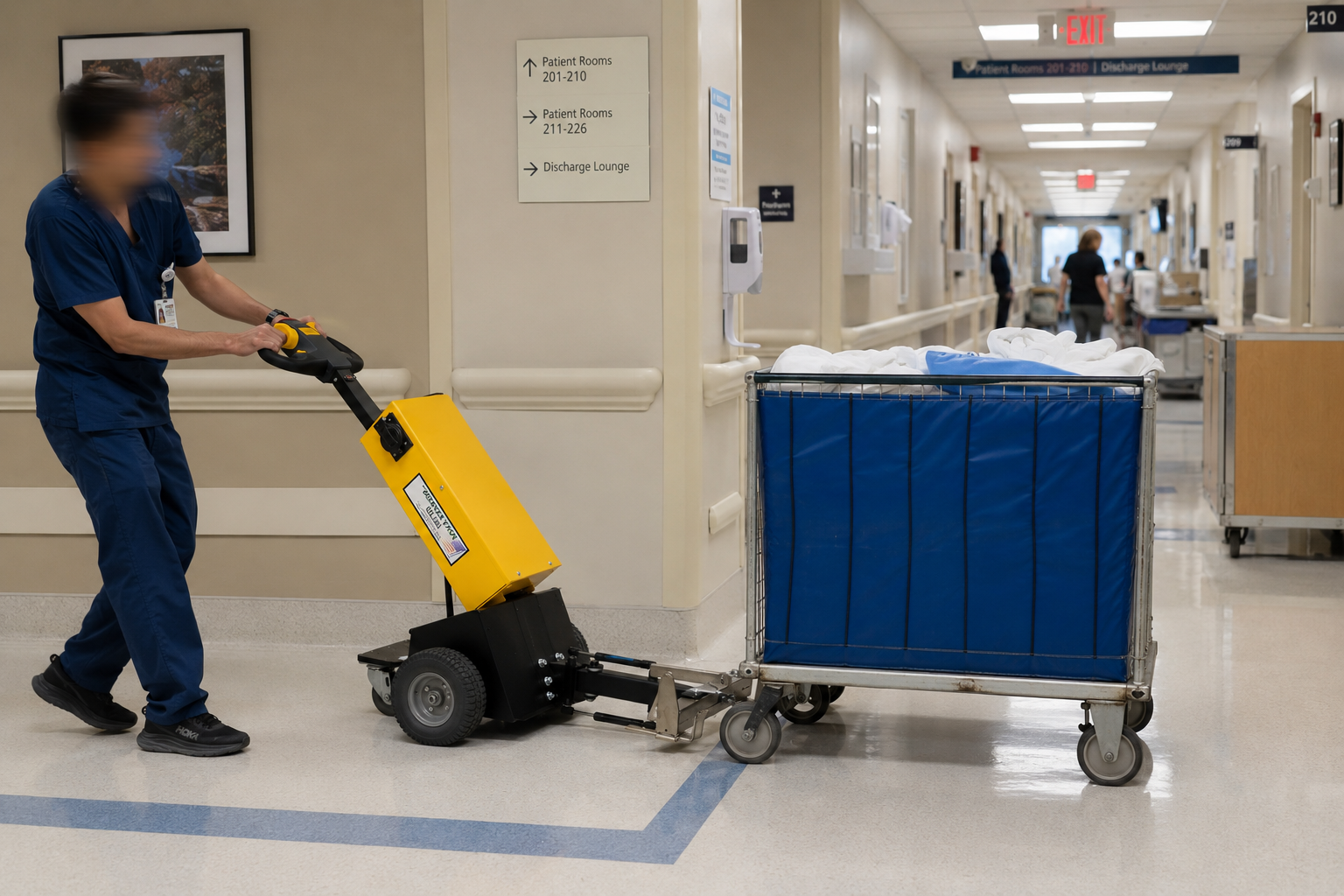
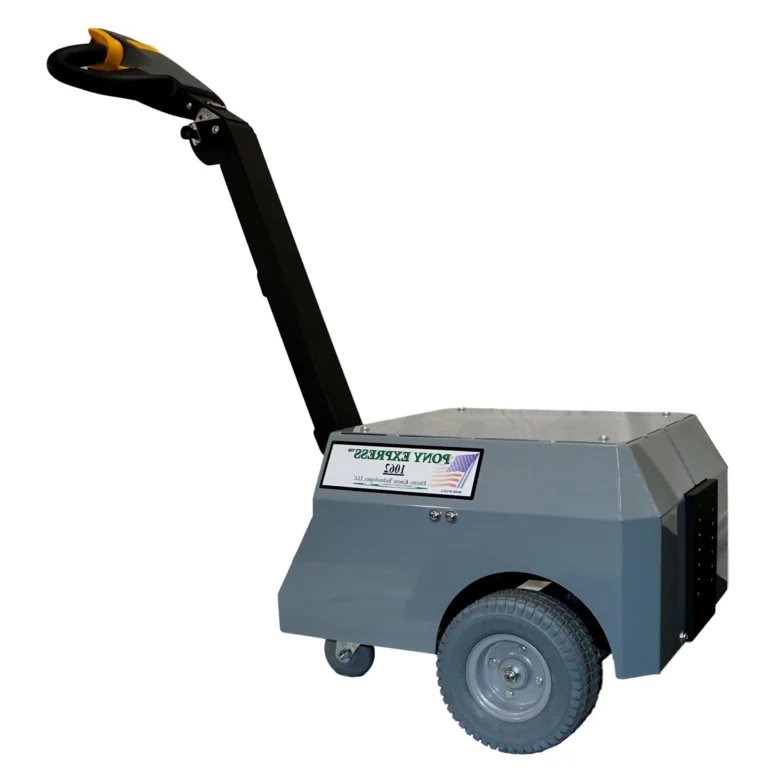
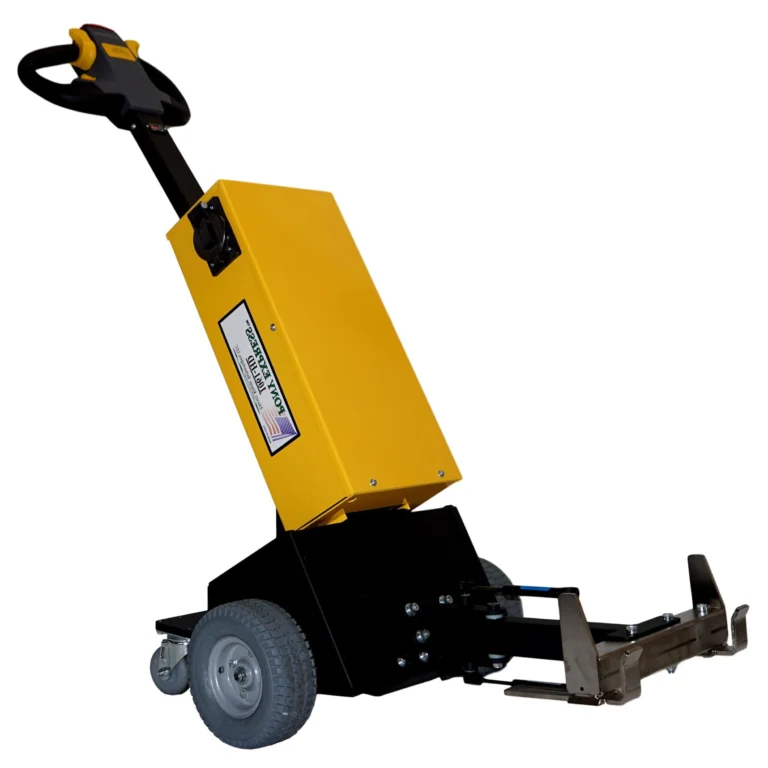
The Pony Express 1061, 1061 Lithium, 1061-HD, 1061-HD Lithium, and 1062 cover the compact tier. Want a pack you swap instead of charge? Compare every lithium tugger side by side. Pull capacity is 1,500 lb on the base 1061 models and 2,000 lb on the HD and 1062 variants. These are the right choice for healthcare facilities moving linen and gas cylinder carts, hotel laundry rotations, mailroom rounds, light retail stock movement, and small-warehouse pick paths. Operating noise under 65 dBA suits indoor environments where ride-on equipment would be disruptive. Compact units weigh 175 lb, light enough to relocate between floors with a service elevator.
Medium-duty (5,000 to 7,500 lb pull)
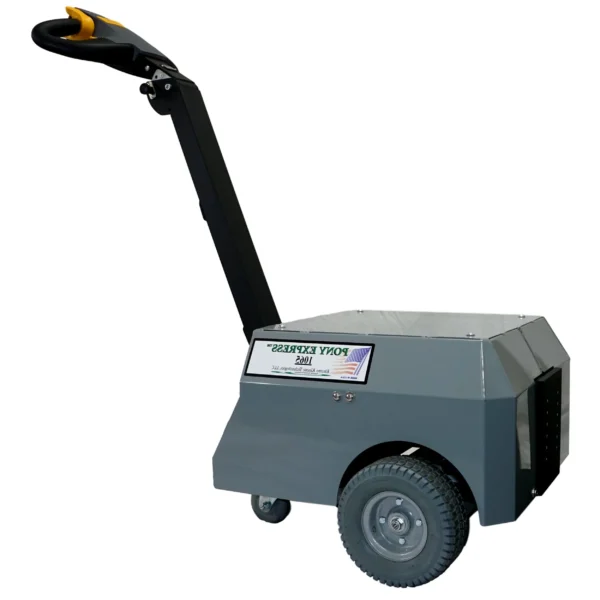
The 1065, 1065 Lithium, 1065-600, 1065-HD, and 1065-XHD make up the medium tier, all sharing the same 25 inch by 24 inch chassis footprint. The 1065 base model handles 5,000 lb and weighs 413 lb. The 1065-HD handles 6,500 lb at 465 lb. The 1065-XHD handles 7,500 lb at 475 lb. The pull-capacity step-up from one variant to the next comes from motor and drivetrain, not chassis size, so all three fit identical aisles. These are the workhorses for warehouse pick paths, automotive and aerospace component movement, food and beverage line operations, and any operation moving multi-thousand-pound rolling carts daily. The 1065-LS Linen and Laundry variant adds hospital and commercial-laundry-specific fittings to the 5,000 lb chassis.
AC heavy-duty (25,000 lb on casters, up to 100,000 lb on rails)
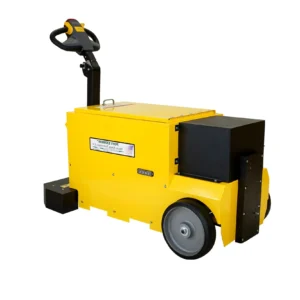
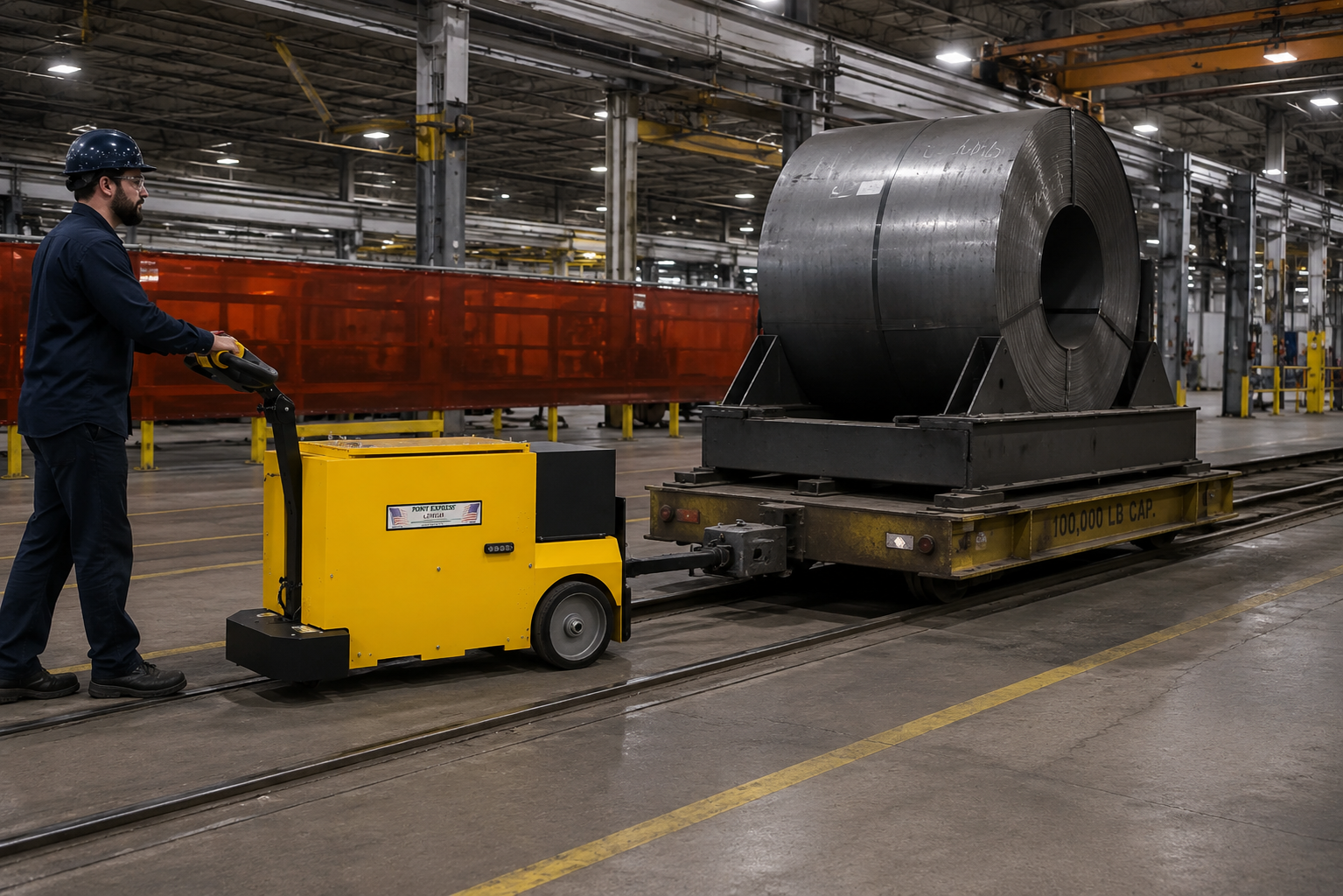
The Pony Express AC Tugger 25K+ is the heaviest unit HDM stocks. It moves 25,000 lb when the load rolls on casters and up to 100,000 lb when the load runs on rails. The dual rating matters. If you have a coil, wind turbine blade, satellite frame, or large machinery on rails, the tugger handles substantially more than its caster rating. The AC Tugger itself weighs 1,200 lb (same chassis for AGM and lithium battery options) on a 52 inch by 30 inch footprint, so plan floor-load and freight accordingly. Buyers comparing the AC Tugger against MasterMover’s heavy-duty Performance line should look at the rail capacity carefully. The AC Tugger is US-built and priced at $20,195, considerably below the typical $40,000-plus price point for comparable ride-on tow tractors.
Walk-behind versus ride-on: pick honestly
Every electric tugger in this collection is walk-behind, also called pedestrian-operated. The operator walks alongside or behind the machine and controls it manually. Walk-behind tuggers excel in tight aisles, hospital corridors, mailroom hallways, and any environment where a ride-on machine would not fit or where the operator covers under 200 yards per move.
Ride-on tow tractors are a different category. They suit large distribution centers where one operator pulls a multi-cart train across long distances. If your operation is moving five carts at a time across a 400,000 sq ft warehouse, ride-on is the right answer, and HDM does not currently stock that format. MasterMover’s Performance range, Crown’s CT series, and Toyota’s industrial tow tractors are the names to research. If you are moving one cart at a time across distances under a few hundred yards, walk-behind is faster to deploy, cheaper to maintain, and easier to operator-train.
Raphael’s field perspective: “I’ve fitted or directly overseen about 180 electric tugger installations across my 9 years in this space, including 11 Pony Express units in healthcare and warehouse settings. Before joining HDM I worked as a field service technician for a material handling equipment distributor, which gave me hands-on time with MasterMover, Crown, and other ride-on platforms. The honest answer when buyers ask ‘walk-behind or ride-on?’ is that move distance and aisle width decide it, not the price tag. If you are inside 200 yards per move and your aisles are under 8 feet wide, walk-behind wins. Outside those, look at ride-on.” Raphael Perlmann, Lead Equipment Applications Specialist
Industry use cases
Hospitals and healthcare facilities
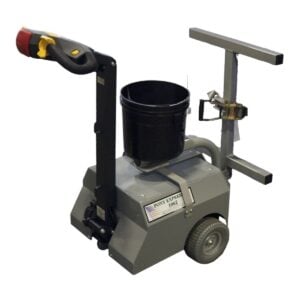
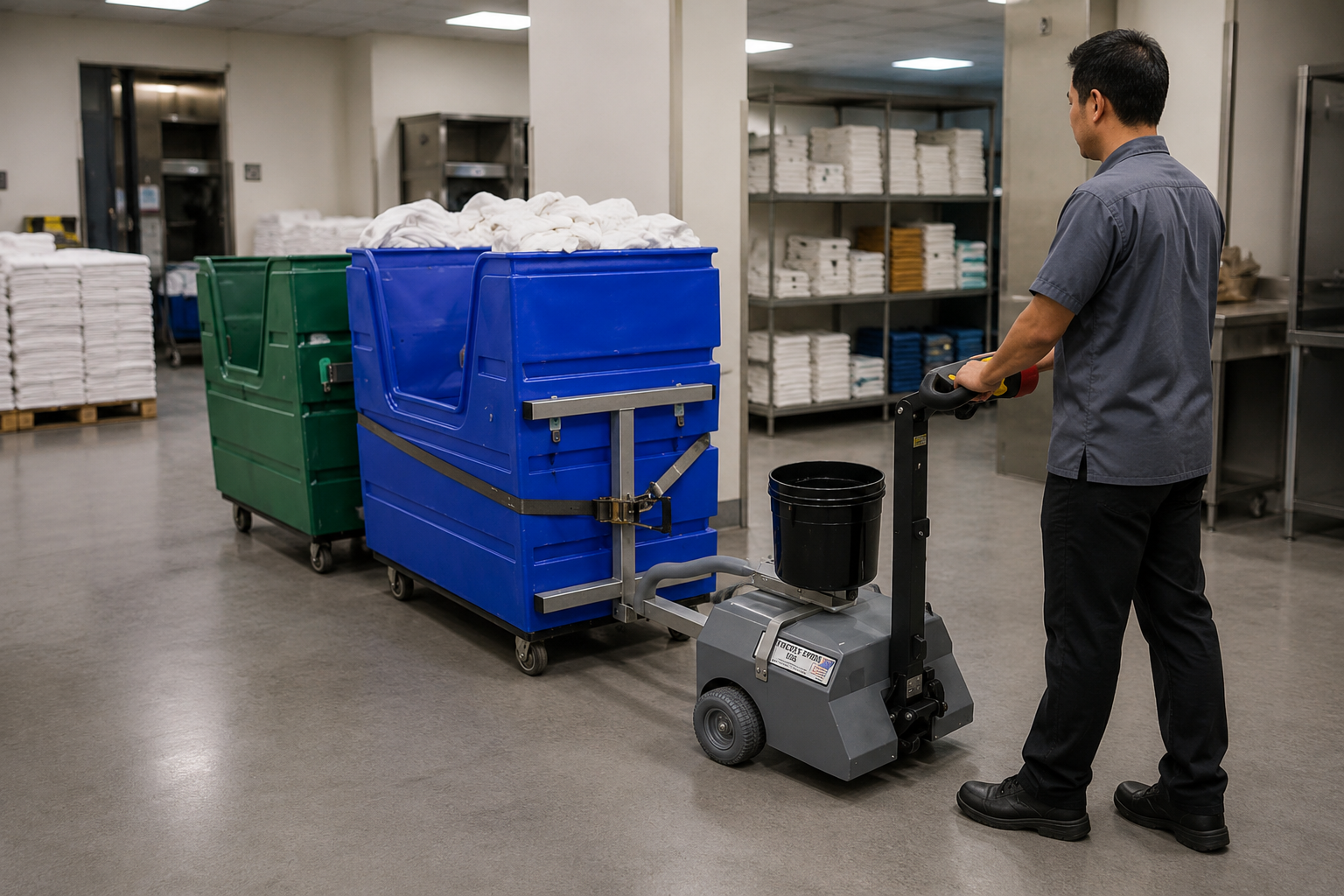
Linen carts on hospital floors typically weigh 800 to 1,500 lb when loaded. A 2,000 lb 1061-HD or 1062 covers most floor-to-laundry rotations without overshooting. The 1062-LS linen cart tugger is the same chassis with the strap bracket and cart hitches fitted. For gas cylinder transport, the Pony Express Motorized Medical Gas Cylinder Cart is purpose-built. For larger laundry operations the 1065-LS handles 5,000 lb. Both linen builds sit side by side on our laundry tugger page.
From a recent fitting: “I fitted a Pony Express 1061 Lithium in a 320-bed hospital’s central laundry last quarter. The compact chassis ran through their 30-inch service doorways with clearance, which mattered because moving the washers and dryers to make space for a larger machine would have cost six figures. The laundry staff reported reduced back strain inside the first few shifts. Six hospital laundry deployments later, the 1061 family is the unit I default to for sub-200-bed facilities.” Raphael Perlmann, Lead Equipment Applications Specialist
Hotels and commercial laundry
Hotel housekeeping rounds and commercial laundry operations push heavy linen bins across long corridors and parking-lot connectors. The 1065-LS is the linen-specific variant. For smaller properties, the 2,000 lb compact tier is often sufficient.
Warehouse and distribution
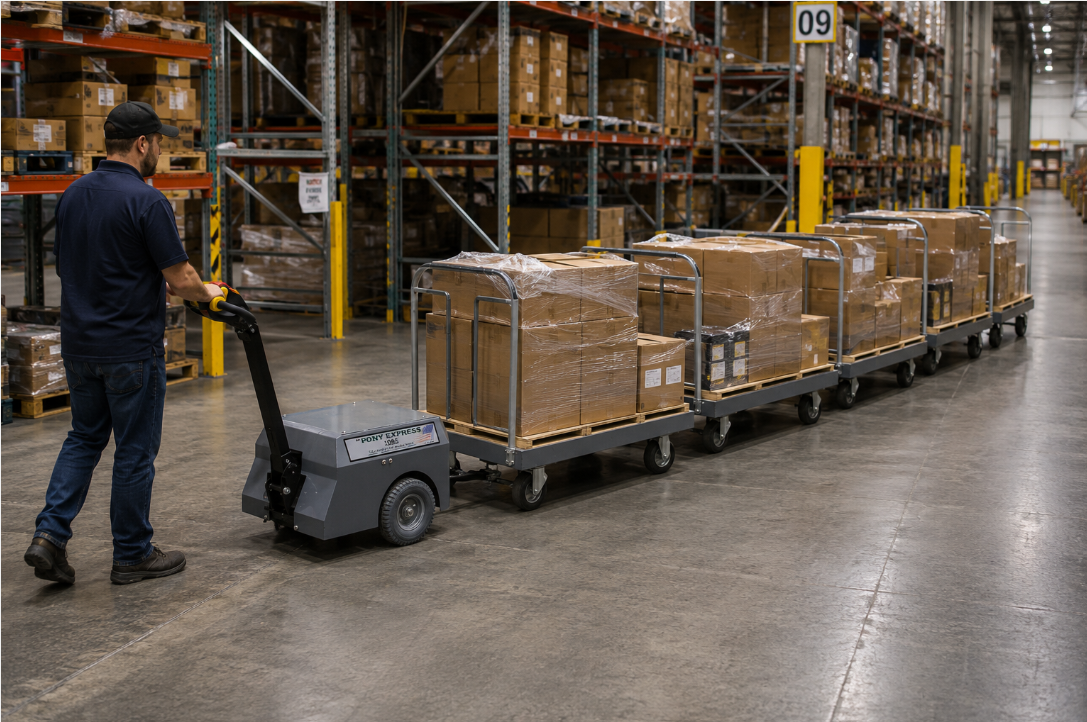
Pick-path work and cart-to-staging moves are where the 5,000 to 7,500 lb medium-duty tier earns its keep. Foam-filled puncture-proof tires handle warehouse floor debris without flats.
Manufacturing, aerospace, automotive
Component movement between workstations, assembly-line feed, and finished-goods transfer are standard medium-duty applications. The AC Tugger covers the heavier industrial moves where line-side rail-mounted loads need to be repositioned.
Mailrooms and office facilities
Internal mail delivery, secure document transport, and office supply replenishment are compact-tier work. The Pony Express 1031-SM01 Motorized Mailroom Cart in our broader motorized carts catalog is also purpose-built for mailroom rounds.
Safety, OSHA, and operator training
This is where competitor sites publish confidently wrong information. Some claim electric tuggers require no operator certification; others claim every operator must be OSHA-certified. The accurate answer follows OSHA’s own classification system, and it is worth getting right because the workplace stakes are real.
What OSHA actually requires: All powered industrial trucks (PITs) fall under 29 CFR 1910.178. The standard’s Appendix A classifies trucks into seven types. Walk-behind electric tuggers like the Pony Express compact line are Class III (“Electric Motor Hand Trucks or Hand/Rider Trucks”). Ride-on electric tow tractors are Class VI (“Electric and Internal Combustion Engine Tractors”). Both classes are covered. Under 29 CFR 1910.178(l)(3), formal operator training and a workplace evaluation are required regardless of class. What varies is the training content. OSHA’s June 15, 1999 Letter of Interpretation to Victor F. Kraker, CSP established that training must cover the specific truck type an operator will use, but operators trained on the same type from a different manufacturer typically do not need to retrain.
About “OSHA certification”: OSHA itself does not issue operator certifications or licenses. The standard requires the employer (or a designated trainer) to provide training and conduct a workplace evaluation, then document the operator’s competency. “OSHA-certified” in everyday workplace langauge means “trained and evaluated per 1910.178(l)”, not a license issued by OSHA. When you see marketing copy that says “no certification required,” that may be technically true (OSHA does not certify) but misleading: training and workplace evaluation are still required.
Raphael has personally trained more than 40 customer teams on safe tugger operation, load limits, daily inspection procedures, and practical application of OSHA guidelines for pedestrian equipment. Practical training topics for HDM buyers typically include load-capacity de-rating on inclines, daily pre-shift inspection of the dead-man handle and emergency stop, multi-cart hitch checks, and floor-debris awareness on warehouse surfaces.
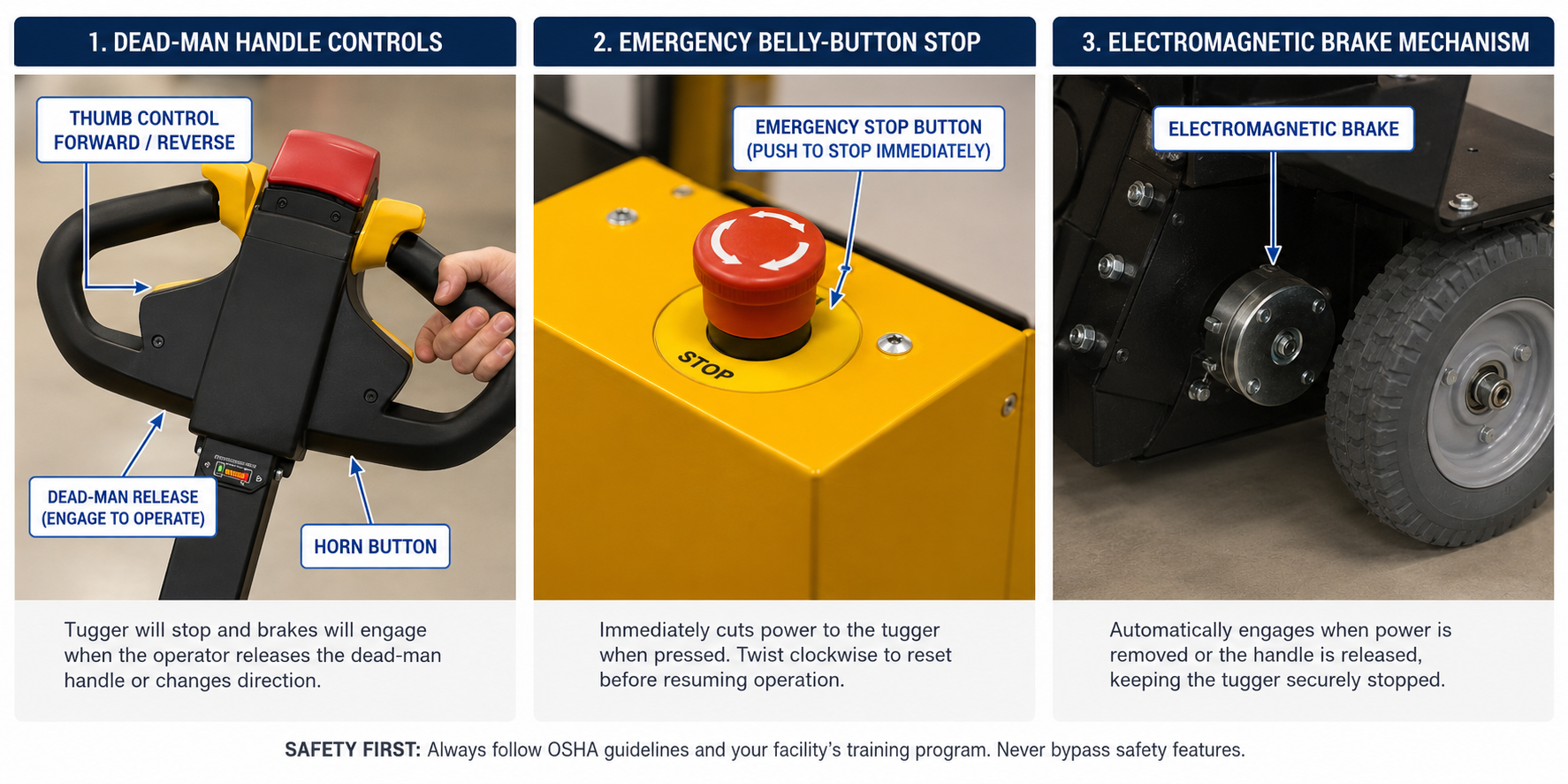
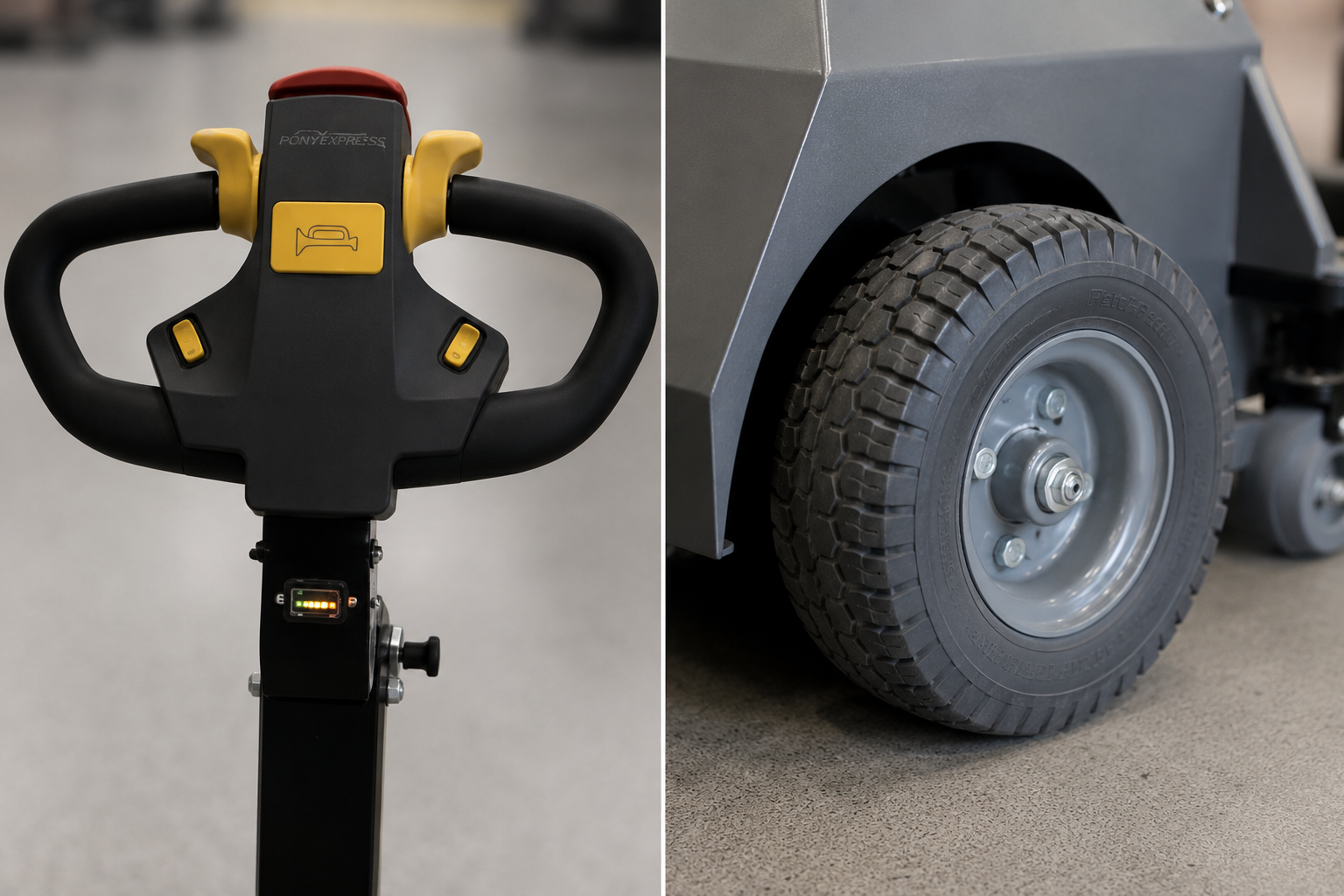
All Pony Express tuggers ship with safety features that reduce operator-injury risk regardless of cert requirements: dead-man operation (the unit stops when the operator releases the handle), an emergency belly-button stop switch, an automatic holding brake on inclines, and electromagnetic parking brakes. Operating noise under 65 dBA reduces hearing-protection requirements in indoor environments.
How to read Pony Express model numbers
This category has a real reseller-side inconsistency problem worth flagging up front. Different resellers list different capacity numbers for the same Pony Express model, depending on whether they cite the manufacturer’s recommended pull capacity on a flat surface (what we use throughout this page), the rolling-load tow capacity (what the unit can sustain once moving on flat ground, typically higher), or a nominal nameplate figure. The safest number to size against is the pull capacity, because that is the load the motor and brakes are rated to start and stop.
Cross-reseller cheat sheet: If you see a Pony Express 1061-HD listed as “5,000 lb” by another reseller, that is the rolling-load tow figure, not the rated pull. EK Tech’s authoritative pull-capacity ratings are below. Items marked ⚠ are not currently stocked at HDM. We can source them through EK Tech with a 4 to 8 week lead time; call or contact us to reserve or get an ETA.
Pony Express 1065-LS: 5,000 lb pull (linen and laundry-specific fittings). In stock.
Pony Express 1065-HD: 6,500 lb pull (heavy-duty 1065). In stock.
Pony Express 1065-XHD: 7,500 lb pull (extra-heavy-duty 1065). In stock.
Pony Express AC Tugger 25K+: 25,000 lb on casters, up to 100,000 lb on rails. In stock.
Coming soon: 4 additional Pony Express models
Four Pony Express variants are not yet in HDM’s standard inventory but can be sourced through our EK Tech relationship for buyers who need them. We coordinate the order, freight, and the 21-day in-facility demo where applicable. Lead times typically run 4 to 8 weeks from confirmed purchase order. Reserve any of the below now and we will lock pricing and confirm delivery window before you commit.
Pony Express 1061 Lithium (base lithium, 1,500 lb pull): Same chassis as the 1061 base with lithium battery upgrade for faster recharge and longer cycle life. Call or contact us to reserve.
Pony Express 1065 Lithium (medium-duty lithium, 5,000 lb pull): Newer lithium variant of the 1065 family. Ideal for multi-shift operations where AGM recharge windows become a bottleneck. Call or contact us to reserve.
Pony Express 1065-600 (medium-duty, 5,000 lb pull): Manufacturer-flagged “coming soon” variant. Call or contact us for ETA.
Incline rating: 30 degrees with de-rated load capacity (the unit handles steeper grades than typical operations require; HDM publishes the de-rating curve on request)
Doorway clearance: the compact tier has been HDM-fitted through 30-inch service doorways in hospital settings without removing fixed equipment (most recently verified Q1 2026)
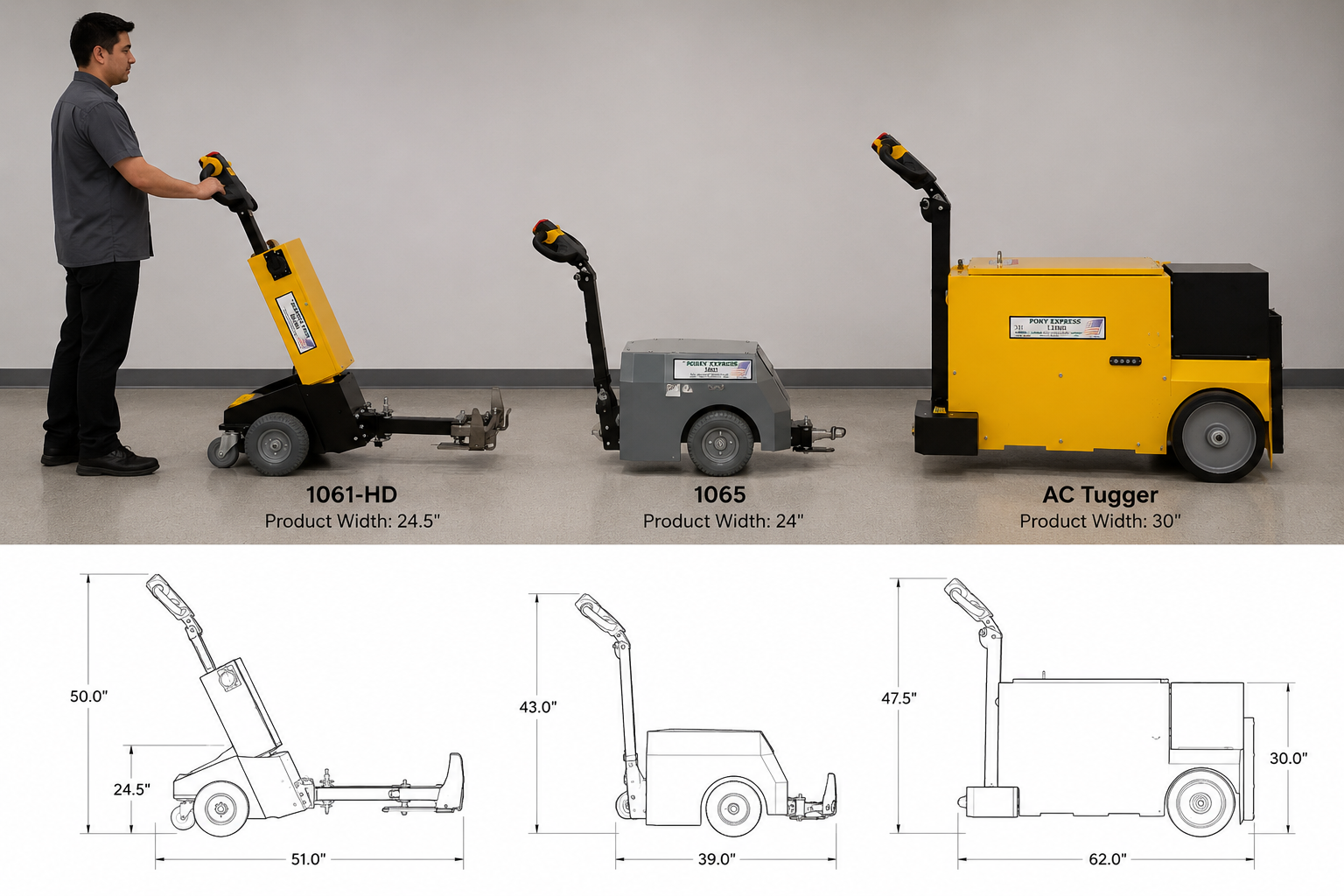
Length: 39 to 54 inches adjustable (1061-HD); 25 inches (1062)
Width: 24.5 inches (1061-HD); 24 inches (1062)
Unit weight: 175 lb (1061-HD AGM and 1061-HD Lithium share the same chassis weight; the lithium variant uses a 40 Ah quick-change Li-ION pack vs the 35 Ah AGM). The 1062 footprint and weight are comparable to the 1061-HD.
Turning radius: approximately equal to unit length for a walk-behind tugger pivoting around the drive wheel. Plan for 25 inches on the 1062 and the adjustable 39 to 54 inches on the 1061-HD. Final figure depends on hitch and trailer geometry; HDM confirms during fitting.
Speed: 0 to 1.5 mph low setting / 0 to 3.0 mph high setting
Battery (AGM models): 35 Ah AGM deep cycle; 70 Ah AGM available as option on the 1062
Operation per charge (AGM): approximately 8 hours at a typical 30 to 40 percent duty cycle; continuous heavy towing reduces, light intermittent use extends
Recharge time (AGM): approximately 4 hours from depleted on 120/240 VAC, 47-63 Hz, UL / cUL / CE listed onboard smart charger
Battery (Lithium variants): 40 Ah quick-change Li-ION pack on the 1061-HD Lithium. Faster recharge (typically 2 to 3 hours) and roughly 2x cycle life vs AGM; quick-change battery enables hot-swap for multi-shift operations.
Parking brake: Electromagnetic with automatic holding brake on inclines
Chassis: Welded steel, powder-coated finish
Drive wheel: Puncture-proof, non-marking
Operating temperature: -40°C to +70°C (-40°F to +158°F)
Charging temperature: -23°C to +60°C
Noise level: Under 65 dBA
Ingress protection: IP 42 chassis / IP 54 controller
All 1065-family variants share the same 25 inch by 24 inch chassis footprint. The pull-capacity step from one variant to the next comes from motor and drivetrain, not chassis size.
Unit weight: 413 lb (1065 base), 465 lb (1065-HD), 475 lb (1065-XHD). The 1065-LS adds modest weight for its linen-cart hitch and fender fittings on the 1065 base chassis.
Turning radius: approximately 25 inches across the family (matches unit length for a walk-behind tugger of this footprint), confirmed during fitting for your specific hitch and trailer geometry
Speed: 0 to 1.5 mph low setting / 0 to 3.0 mph high setting
Motor: 24V high-torque DC with dual speed control and regenerative braking
Battery (AGM): 70 Ah deep-cycle AGM, approximately 8 hours operation per charge, 4 hour recharge on 120/240 VAC
Battery (Lithium variants): faster recharge and longer cycle life; specifics vary by variant
Incline rating: 30 degrees with de-rated load (HDM has field-observed full rated load held cleanly on 4 percent sustained gradient with regenerative braking engaged, verified Q1 2026)
Tires: Foam-filled, puncture-proof, non-marking
Chassis: Welded steel, powder-coated
Operating temperature: -40°C to +70°C
Noise level: Under 65 dBA
Ingress protection: IP 42 chassis / IP 54 controller
1065-LS variant: Linen and laundry-specific hitch and fender fittings for hospital and commercial laundry environments
AC heavy-duty (AC Tugger 25K+)
Pull capacity: 25,000 lb on casters / up to 100,000 lb on rail-mounted loads
Length: 52 inches
Width: 30 inches
Unit weight: 1,200 lb (same chassis for both AGM and lithium battery options; the battery pack itself adds about 25 lb either way and is quick-swap on the AC Tugger). Plan floor-load and freight accordingly.
Turning radius: The AC Tugger is typically deployed in fixed-path or rail-system applications where turning radius is engineered into the floor layout rather than the tugger itself. For caster-rolled load applications, plan for approximately the unit length (52 inches) plus your load’s lateral clearance.
Speed: 0 to 1.5 mph low / 0 to 3.0 mph high
Motor: 48V AC industrial drive with regenerative braking
Battery (AGM): 48 VDC, 100 Ah deep-cycle AGM, approximately 4 to 6 hour recharge; quick-swap design
Battery (Lithium option): 48 VDC, 120 Ah lithium iron phosphate (LiFePO4). Recharges in approximately 90 minutes, 6x faster than AGM, 100 percent of rated capacity regardless of discharge rate, suitable for multi-shift operations; quick-swap design.
Battery management: Bluetooth fleet-monitoring app for state-of-charge and usage tracking across multiple units
Coupling: Jog-control coupling assist (front-mounted switch for precise hitch alignment); customizable hitches and couplers available
Motor protection: Built-in motor sensors throttle back drive on thermal overload; solid-state sensor prevents operation when the mast is improperly positioned
Incline rating: Application-specific (“consult factory”). The AC Tugger is typically scoped for rail-mounted or fixed-path applications where gradient is part of the engineering brief.
Operating temperature: -40°C to +70°C
Charging temperature: -23°C to +60°C
Noise level: Under 65 dBA
Ingress protection: IP 42 chassis / IP 54 controller
For most buyers evaluating their first electric tugger, the Pony Express 1065 is the right starting point. The 5,000 lb pull capacity covers the bulk of warehouse, hospital laundry, and light-manufacturing daily moves without overshooting the budget on heavier units. The 24V high-torque motor with dual speed control and regenerative braking handles inclines up to 30 degrees with de-rated load. Foam-filled puncture-proof tires reduce maintenance. The 2-year frame-and-drive warranty covers the welded steel chassis and the drive system, with 1 year on other parts.
Raphael’s notes from the field: “I have fitted the 1065 in two distribution facilities. Both ran mild inclines around 4 percent gradient with full rated loads, and the regenerative braking held the cart cleanly on the down-slope without operator pushback. The handle is well-balanced for sustained shift work; operators reported less wrist strain than they had with older non-regenerative units.” Raphael Perlmann, Lead Equipment Applications Specialist
For lighter loads under 2,000 lb, step down to the 1061-HD or 1062. For 6,500 lb or 7,500 lb pull, step up to the 1065-HD or 1065-XHD (same chassis, stronger motor). For rail-mounted industrial loads, the AC Tugger is the answer.
21-day demo program, financing, and what HDM coordinates
EK Tech runs a 21-day manufacturer demo program for qualified buyers across Retail, Healthcare, and Material Handling product lines. HDM coordinates the request. The current terms (as of the program’s June 2024 update) are a $60 non-reusable shipping carton fee, a $250 refundable security deposit, customer-paid outbound and return shipping, Visa or MasterCard payment, and a $50/day rental charge if the unit is not returned within 21 days. Custom-built units are not eligible. Demo requests start with a quick fit conversation about your application, load type, and facility constraints.
Klarna financing is available on Pony Express tuggers up to our $10,000 per-transaction ceiling. That covers every in-stock model from the 1061-HD ($4,752) through the 1065-XHD ($8,949). The AC Tugger 25K+ at $20,195 falls above the standard Klarna ceiling. Contact us for the AC Tugger or for any higher-volume order (multi-unit fleet purchases, multi-site rollouts) and we will route through commercial financing or equipment-leasing partners. All Pony Express tuggers ship free in the continental US on most models.
Talk to HDM before you commit
If you are not sure which capacity tier fits your operation, send us your application details (load type, typical weight, distances, surface, shift hours, current pain points) and we will help you size correctly. The 21-day demo program is the safest way to confirm a fit before a multi-thousand-dollar commitment. Reach out or browse the rest of the motorized carts catalog.
Browse electric tuggers by capacity and size
Two child pages split this range so you can shop by the number that matters to you. For loads above 2,000 lb, step up to the heavy-duty electric tuggers. The 1065 pulls 5,000 lb, the 1065-HD pulls 6,500 lb, the 1065-XHD pulls 7,500 lb, and the AC Tugger handles 25,000 lb on casters and up to 100,000 lb on rail-mounted loads. They share aisle-friendly chassis footprints, so heavier capacity does not cost you maneuverability.
If your loads stay at or below 2,000 lb and your aisles are tight, look at the compact and small electric tuggers. The 1061-HD pulls up to 2,000 lb on a 24.5-inch-wide chassis that adjusts from 39 to 54 inches long, and the 1062 does the same on a 24-inch-wide, 25-inch-long frame, so both thread tighter aisles than a 1065-class unit. Both child pages roll up to this hub, so start here to compare the full walk-behind range, then drill into the page that matches your load and your floor.
Two more collections use the same walk behind drivetrains on a different attachment. Dumpster movers latch to a bracket on a waste container and push or pull loaded bins from 2,000 lb up to 50,000 lb roll off boxes. Electric aircraft tugs take an aircraft nose wheel instead of a cart hitch and move planes from 4,000 lb up to 35,000 lb. If your load is not a cart, start on one of those.
Lithium-ion versus lead-acid power, which to specify
Choose lithium if you run two or three shifts a day, lead-acid AGM if you run a single shift. That is the short answer, and the math behind it is straightforward. The deep-cycle AGM battery that ships standard on the 1061-HD and 1062 gives roughly 8 hours of runtime and recharges in about 4 hours on the onboard UL listed smart charger. One shift, one overnight charge, no opportunity charging needed. AGM costs less up front and is the practical pick for the majority of single-shift hospital, warehouse, and mailroom operations.
Lithium changes the equation when the unit cannot sit idle long enough to recharge. The 1061-HD Lithium is the only in-stock lithium model in this collection and it carries a 40 Ah pack against the AGM 35 Ah. Lithium accepts opportunity charging during breaks, holds voltage flatter as it depletes so pull power does not sag late in a shift, weighs less, and carries no acid to vent or spill. It costs more at purchase. For a two-shift floor that would otherwise buy a second AGM unit just to cover the charge window, one lithium unit often comes out ahead over the equipment life.
Raphael on specifying battery chemistry. I size the battery to the charge window, not the catalog. If the tugger gets 6 uninterrupted hours on a charger every 24, AGM is plenty and I save the buyer the lithium premium. If it has to run back-to-back shifts with only meal-break gaps to top up, lithium earns its cost inside the first year on a busy floor. I have specified the 1061-HD Lithium for three two-shift laundry rooms where a single AGM unit would have stranded the second shift mid-round.
The 1065 family and the AC Tugger offer the same AGM-or-lithium choice on their larger chassis. The decision logic is identical, match the chemistry to your charge window and shift pattern, not to the spec sheet headline.
Equipment Trusted by Industry Leaders
Built in Germantown Wisconsin with custom engineered solutions for payloads up to 70,000 lbs. The same tuggers and motorized carts we sell move daily loads at these organizations.
Logos identify organizations that use EK Tech equipment. All trademarks are the property of their respective owners.
Industries and Applications Served
From aerospace plants to hospitals, this equipment is built for the loads, duty cycles and environments of these industries.
Aerospace
Automotive
Beverage
Pharmaceutical
Glass
Construction Machinery
Engine Equipment Manufacturing
Healthcare
Light Manufacturing & Assembly
Heavy Manufacturing & Assembly
Casinos & Resorts
National Security & Defense
Railroads
Mining
Paper Mills
Copper Rolling
Iron & Steel Mills
Plastics
Hotels & Amusement Parks
Retail
Wood Product Manufacturing
Dairy Product Manufacturing
Pulp, Paper & Paperboard Mills
Oil & Gas
Structural Metals Manufacturing
Fabricated Metal Products
Agriculture & Mining Equipment
Medical Equipment
Frequently Asked Questions
What is an electric tugger?
An electric tugger is a battery-powered walk-behind machine that tows wheeled carts, trailers, and rolling equipment. It does not lift, it tows. Operators walk behind it using ergonomic handle controls. Capacities at HDM run from 1,500 lb to 25,000 lb on casters, and up to 100,000 lb on rails for the AC Tugger.
What is the difference between a tugger and a forklift?
Forklifts lift pallets and loads vertically. Tuggers tow wheeled loads horizontally. They are different machine categories with different operator-training requirements under OSHA's powered-industrial-truck classes. Use a forklift to move a static pallet. Use a tugger to move anything already on wheels.
Do operators need OSHA certification to use an electric tugger?
OSHA does not issue operator certifications directly. Under 29 CFR 1910.178(l)(3), employers must provide formal training and conduct a workplace evaluation for every operator of a powered industrial truck. Walk-behind tuggers (Class III) and ride-on tow tractors (Class VI) both fall under this requirement. The training content varies by truck type. See OSHA's June 1999 Letter of Interpretation to Victor F. Kraker, CSP for the type-specific principle. "OSHA-certified" in everyday workplace langauge means "trained and evaluated per 1910.178(l)", not a license issued by OSHA.
How long does the battery last per charge?
Compact AGM models (1061-HD, 1062) run approximately 8 hours per charge at a typical 30 to 40 percent duty cycle on the 35 Ah deep-cycle battery. The 1065 base ships with a larger 70 Ah AGM pack at the same 8-hour rating because the heavier motor draws more under load. Continuous heavy towing on the upper edge of the rated pull reduces runtime to roughly 5 to 6 hours; light intermittent use stretches it past a full shift. Lithium variants on the same chassis recharge faster (typically 2 to 3 hours from depleted vs 4 hours for AGM) and roughly double the battery cycle life. The AC Tugger 25K+ uses a 48 VDC architecture with either a 100 Ah AGM (4 to 6 hour recharge) or a 120 Ah LiFePO4 lithium pack that recharges in roughly 90 minutes. The lithium option is the typical choice for two-shift or three-shift industrial operations.
AGM versus lithium batteries: which is right for daily use?
AGM is the standard, more affordable, and rated for daily single-shift use. Lithium variants (1061 Lithium, 1061-HD Lithium, 1065 Lithium when in stock, and the AC Tugger 25K+ LiFePO4 option) cost more upfront but deliver faster recharge (90 minutes to 3 hours depending on model vs 4 to 6 hours for AGM), longer cycle life (roughly 2x AGM cycles), and lower weight. For two-shift operations or multiple charge cycles per day, lithium pays back. For single-shift use, AGM is the practical choice.
Can I finance an electric tugger purchase?
Yes. Klarna financing is available up to our $10,000 per-transaction ceiling, which covers every in-stock Pony Express tugger from the 1061-HD ($4,752) through the 1065-XHD ($8,949). For the AC Tugger 25K+ ($20,195) or for multi-unit fleet purchases, contact HDM and we will route through commercial financing or equipment-leasing partners.
Can I rent or try a tugger before buying?
EK Tech offers a 21-day demo program rather than open-ended rentals. The demo lets you evaluate the unit in your actual facility for three weeks. See the "21-day demo program" section above for full terms ($60 carton fee, $250 refundable security deposit, customer-paid freight, Visa or MasterCard).
Are these tuggers made in the USA?
Yes. EK Tech (Electro Kinetic Technologies) manufactures the Pony Express line in Germantown, Wisconsin. This is a meaningful distinction in this market segment where most heavy-duty competitors are imported.
What warranty comes with a Pony Express tugger?
Pony Express tuggers carry a 2-year warranty on the frame and drive system and 1 year on other parts. The welded-steel powder-coated chassis is built to outlast that term.
Can one operator move multiple carts at once?
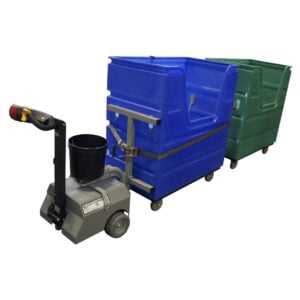
Yes, with the right hitch configuration. Pony Express tuggers support multi-cart trains within the unit's rated pull capacity (so three 1,500 lb carts together stay under a 5,000 lb 1065's pull rating). For long cart trains across long distances, ride-on tow tractors are still the better tool; walk-behind units are optimized for shorter point-to-point moves.
How much does an electric tugger weigh?
Compact-tier units (1061-HD, 1061-HD Lithium, 1062) weigh 175 lb. Medium-duty 1065-family units weigh 413 lb (1065 base, 1065-LS), 465 lb (1065-HD), or 475 lb (1065-XHD). The AC Tugger 25K+ weighs 1,200 lb in both AGM and lithium configurations (the quick-swap battery itself is about 25 lb). Unit weight matters for floor-load planning on raised floors and elevated decks, and for freight planning at delivery.
What turning radius and doorway width can the compact tier handle?
The compact tier (1061 series, 1062) has been fitted by HDM through 30-inch service doorways in hospital settings without removing fixed equipment (most recently verified Q1 2026). The 1062 footprint is 25 inches long by 24 inches wide, and its turning radius is approximately the unit length (25 inches when pivoting around the rear drive wheel). The 1061-HD has an adjustable 39 to 54 inch length and turns within that footprint accordingly. Specific turning-radius figures vary by hitch configuration; we walk through them during a fitting conversation. For a tight-corridor or tight-doorway application, send us the corridor width and turning area dimensions and we will recommend the right model and confirm clearance before you commit.
What is the maximum incline grade with rated load?
Compact and medium-duty Pony Express tuggers are rated for inclines up to 30 degrees with a de-rated load. The de-rating curve depends on the model. At 4 percent gradient (a common warehouse ramp), our field observations (Q1 2026) show the 1065 holds full rated load cleanly with regenerative braking engaged on the down-slope. For applications running sustained gradients above 4 to 6 percent, send us the floor map and we will model the de-rated capacity for your specific path. The AC Tugger 25K+ is incline-rated on application basis ("consult factory") because its typical use case involves rail-mounted loads where the gradient is engineered into the rail system, not the tugger.




 4.8
4.8