By Raphael, Founder of Heavy Duty Mobility. Last reviewed June 13, 2026. Meet the team.
Which hospital department needs a powered cart
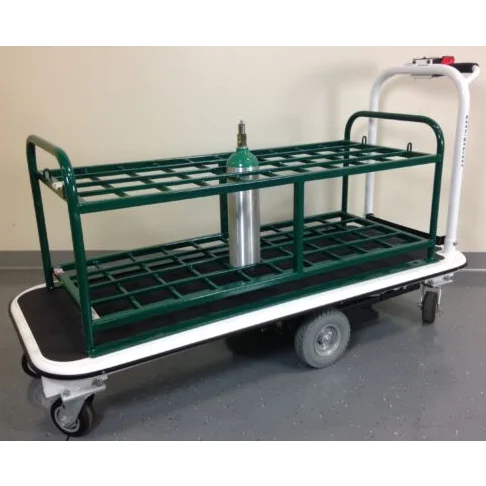
Hospitals move oxygen and medical gas cylinders, soiled linen, and supplies on powered carts across every department. Crash, medication, endoscopy and pharmacy carts built to your spec are on our custom engineered hospital carts page.
Match the cart to the load and the route. A central-supply tech moving 40 oxygen cylinders has a very different problem than a housekeeper hauling soiled linen or a biomed tech relocating a bed. Each of those jobs has a model built for it, and forcing the wrong cart onto a task is how staff get hurt and equipment gets damaged. Here is how the line maps to a care facility.
How do I move medical gas cylinders safely
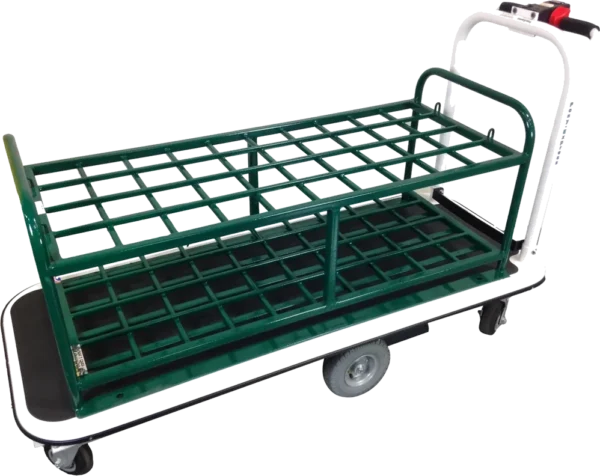
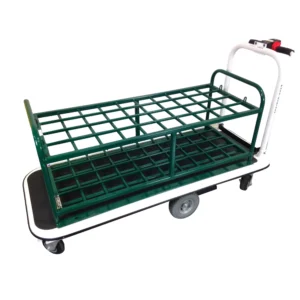
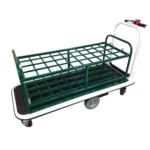
Use a powered cylinder cart that holds the tanks upright and secured, and push it rather than pull it. The motorized medical gas cylinder carts carry 24 to 48 cylinders depending on rack size and are rated up to 2,000 lb. They fit M7, M9, C, D, and E format tanks. Even a small E cylinder is heavy and pressurized enough that a loose tank becomes a struck-by and oxygen hazard, so the rack secures each one upright before the cart moves. We rank first in the country for this category, and the full securement and regulatory detail lives on that page. OSHA addressed cylinder transport on portable carts directly in its 2021 standard interpretation on compressed gas cylinders, and CGA pamphlet G-4 on oxygen covers handling around oxidizers.
What moves soiled linen and laundry without staff strain
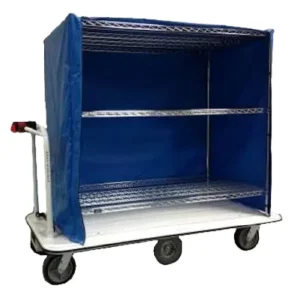
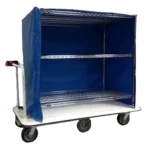
A self-propelled linen cart moves its own load, while a linen tugger tows the carts you already own. The motorized linen and laundry carts include a 1,500 lb self-propelled unit with three adjustable wire shelves and a zip cover. The same family also has the 1065-LS tugger, which pulls up to 5,000 lb when you need to relocate a train of existing hampers. Housekeeping rounds in a large hospital cover real distance, and pushing a loaded hamper by hand is where back and shoulder injuries start. For soiled linen runs that keep your existing carts, a hospital laundry tugger tows a train of them behind one operator.
How do I relocate beds, gurneys, and large equipment
Tow them with an electric tugger sized to the load. Our walk-behind electric tuggers hook to a bed frame, a case-cart train, or a piece of rolling equipment and pull it horizontally on its own casters while one operator walks behind and steers. For loads above 2,000 lb, such as a fleet of stacked case carts, step up to the heavy-duty electric tuggers rated 5,000 to 7,500 lb. These are pedestrian units, not ride-on tow tractors. If your campus needs long-distance multi-cart trains across buildings, a ride-on tractor is a better fit, and we will point you to one.
What handles central supply, case carts, and internal mail
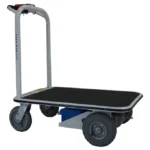
A motorized platform cart carries pallets and case carts, and a mailroom cart runs the internal mail and parcel route. The motorized platform carts start at a 2,000 lb deck and climb to 4,000 lb for heavier central-supply loads. For mail and small-parcel rounds, the motorized mailroom and utility carts add welded baskets and a quieter office-floor profile. One thing to plan for is the warranty. The whole line carries a 2-year frame and drive warranty with 1 year on other parts, so budget for replacement parts accordingly.
Motorized Carts for Hospitals and Clinics
Pony Express for Healthcare
Walk-behind powered carts that move oxygen cylinders, linen, mail, and supplies across departments without manual push or pull strain
Headline spec
1,500 to 5,000 lb Load range across the line
- 5 Healthcare cart models
- Up to 48 Cylinders on the gas cart
- 8 hr Runtime per charge
- Up to 10 mi Distance per charge
- 0 to 3 mph Pedestrian speed range
Load capacity by model
- 1065-LS Linen and Laundry Tugger 5,000 lb
- Medical Gas Cylinder Cart 2,000 lb
- 1031 Platform Cart 2,000 lb
- Motorized Linen and Laundry Cart 1,500 lb
- 1031-SM01 Mailroom Cart 1,500 lb
Where these carts work in a hospital
- Moving oxygen and medical gas cylinders from dock to floor on the cylinder cart that holds up to 48 cylinders
- Running clean and soiled linen between laundry and patient wings at up to 1,500 lb per load
- Mailroom and parcel rounds across long corridors with the two-basket 1031-SM01
- Towing carts and supply trains up to 5,000 lb with the 1065-LS linen tugger
- General supply and equipment moves on the 2,000 lb 1031 platform cart
This line carries a 2-year frame and drive warranty with 1 year on other parts, so match the model to the department before you buy.
Why powered beats manual in a care setting
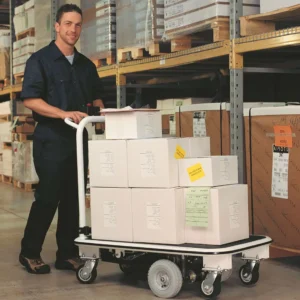
The force a person can safely push all day is lower than most facilities assume. NIOSH puts the sustained push-force ceiling near 50 pounds of force for repeated handling in its Ergonomic Guidelines for Manual Material Handling. A loaded linen cart or a rack of gas cylinders blows past that on the very first push. Powered carts take the human out of the engine role, which cuts the strain injuries that drive workers-comp claims and leave a unit short-staffed.
There is a patient-safety angle too. A cart that drives at a controlled 1.5 to 3 mph with regenerative braking and an automatic holding brake will not run away on a ramp or roll into a corridor when the operator lets go. That matters far more in a hospital than in a warehouse, where the only thing in the aisle is more inventory.
Raphael’s rule for facility buyers. Buy the cart for the heaviest real load on your worst route, not the average one. A gas-cylinder cart that handles 40 tanks on a flat floor still needs the 6-degree incline rating to clear the loading-dock ramp behind central supply. I walk the actual route with facility leads before recommending a model, because the ramp, the door width, and the elevator depth decide the cart more often than the headline capacity does. We also run a 21-day manufacturer demo program so your staff can prove the fit on your own floor before you commit.
What every Pony Express healthcare cart shares
The line runs on common hardware, which keeps training and parts simple across a fleet. Every unit uses a 24V deep-cycle AGM battery with an onboard UL listed smart charger. You get up to 8 hours of runtime and roughly 10 miles per charge, with a recharge of about 4 hours from a standard 100 to 240 VAC outlet. Each one runs under 65 dBA, so it will not disrupt a patient floor. Foam-filled non-marking tires, a keyed switch, an e-stop, a horn, and regenerative braking are all standard. Most models use center-wheel drive for a tight turning radius in elevators and doorways.
Warranty is 2 years on the frame and drive across the line, with 1 year on other parts. That term applies to every model, including the 1031-SM01 mailroom cart and the electric scissor-lift cart. Compliance and life-safety in a healthcare facility also follow OSHA 1910.101 on compressed gases and the NFPA 99 Health Care Facilities Code, which govern how gas cylinders are stored and moved in the building.
Our top pick for healthcare buyers
For most hospitals the first cart to buy is the Pony Express Motorized Medical Gas Cylinder Cart at $4,549 on sale from $5,282. It moves 24 to 48 cylinders, holds up to 2,000 lb, fits M7, M9, C, D, and E tanks, and is rated for a 6-degree incline so it clears most dock ramps. It solves the single highest-risk handling job in the building. From there, layer in the linen and laundry carts for housekeeping and a tugger for bed and equipment moves.




 4.8
4.8