Filters
Motorized Office, Mailroom & Utility Carts
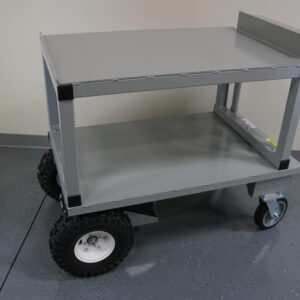
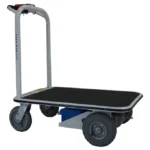
A motorized utility cart carries your tools, parts, and parcels around a building so your team is not pushing a loaded cart by hand all day. The two carts on this page are walk-behind units built for offices, mailrooms, and light assembly floors where the same routes get run shift after shift.
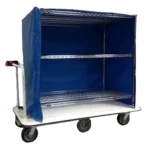
Both run on a 24V deep-cycle AGM battery with a center-wheel drive that turns inside tight aisles, and a thumb throttle that holds a steady 0 to 3 mph forward and reverse. The Office, Commercial and Light Assembly Utility Cart is rated for 1,500 and 2,000 lb and ships with a 40, 49, or 61 inch deck. The 1031-SM01 Mailroom Cart carries up to 1,500 lb on its lower deck and adds two welded baskets sized for mail trays and parcels.
A loaded cart can take far more force to move than a worker should be leaning into all day, which is the reason facilities motorize the route instead of asking staff to muscle it. These are pedestrian-operated carts for rolling a load level across a building. If you need to lift a deck to working height instead, the powered scissor-lift cart is the better tool, and if you need to tow several wheeled carts in a train, an electric tugger does that job. The buying guide below walks through how to choose.
Both carts are US-built by EK Tech in the Pony Express line, and both are in stock.
Our Top Pick

-13%
Off
- Free Delivery

$5,693
$4,968
- Rated for 1,500 and 2,000 lb working loads
- Three deck lengths, 40, 49, or 61 inches
- 5-year frame and motor warranty, made in USA

Showing 1–2 of 2 products
By Raphael, Founder, Heavy Duty Mobility. Last updated June 13, 2026.
Why motorize an office, mailroom, or utility cart?
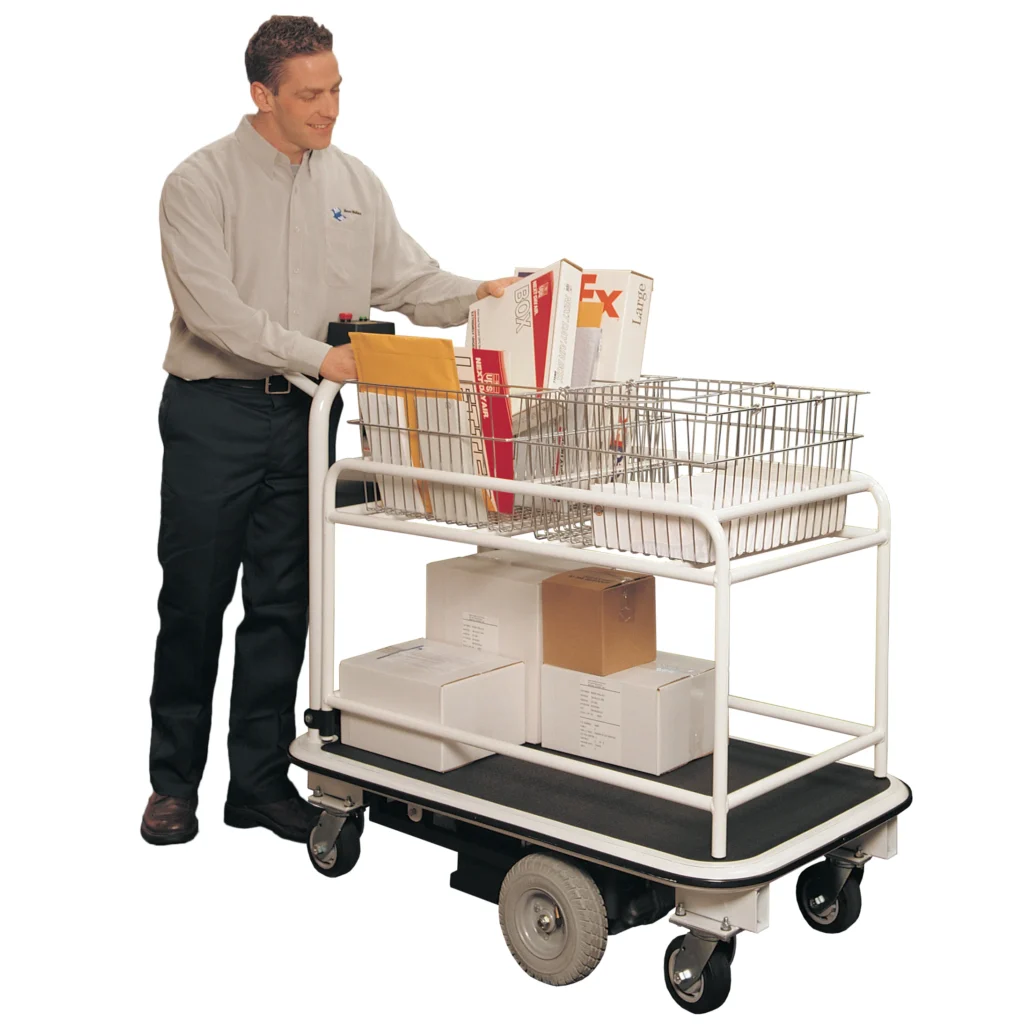
A powered utility cart pays for itself on the routes your staff repeat every shift. A hand cart is fine for a short, light trip across a flat floor. The trouble starts when the load climbs past a few hundred pounds, or the route adds a ramp or a long corridor, because then the person behind the cart is doing work the battery should be doing instead.
NIOSH puts the sustained push force a worker can safely apply over a shift at roughly 50 pounds of force, and a loaded utility cart exceeds that as soon as you add a grade. The same point shows up in OSHA materials handling pushing and pulling guidance, which flags repeated heavy pushing as a back and shoulder strain risk. Motorizing the route takes that strain off your team and keeps the same load moving at a steady 3 mph instead of slowing down as the day wears on.
Both carts here are walk-behind, US-built by EK Tech in the Pony Express line, and both are in stock.
Raphael’s rule of thumb. Buy the deck to the load, not to the aisle. Most facilities over-size the deck because the loading dock is wide, then fight that 61 inch platform through every interior doorway and elevator for the next five years. Measure the largest thing you actually move and the tightest door it has to clear, then size up one step from there. A 49 inch deck threads buildings that a 61 inch deck cannot, and you rarely miss the length.
Pony Express US-built walk-behind
Motorized Office, Mailroom and Utility Carts
Two powered carts that move 1,500 to 2,000 lb without anyone pushing
Headline spec
Utility cart max load
Utility cart deck lengths
40 in
49 in
61 in
Where these carts earn their keep
- Daily mail and parcel rounds across a large office or campus
- Moving tools and parts on a light assembly line
- Hauling supplies between commercial facility departments
- Any route where staff are pushing heavy carts by hand today
The utility cart carries more weight and offers three deck lengths, while the mailroom cart adds two welded baskets and spring suspension but is rated to 1,500 lb with a 2 year frame and motor warranty against the utility cart’s 5 year.
What is a motorized utility cart and how is it different from a hand cart?
A motorized utility cart is a battery-powered, walk-behind platform cart that drives itself under a thumb throttle, so the operator steers instead of pushes. A hand cart relies entirely on the person behind it, and that difference matters most on long indoor routes and ramps. NIOSH puts the sustained push force a worker can apply repeatedly at roughly 50 pounds, and a fully loaded utility cart blows past that the moment you add a grade or a long corridor.
Both carts on this page use a 24V deep-cycle AGM battery and a center-wheel drive for a tight turning radius. They have regenerative braking and an automatic holding brake that keeps the cart still on a slope when you release the throttle. They run 0 to 1.5 mph in low and 0 to 3 mph in high, forward and reverse, with an e-stop, a horn, and a keyed on-off switch.

Frequently asked questions
How much weight can these carts carry?
The Office, Commercial and Light Assembly Utility Cart is rated for 1,500 and 2,000 lb depending on configuration. The 1031-SM01 Mailroom Cart carries up to 1,500 lb on its lower deck. Rate the cart above your real working load, not right at it. A cart run at its ceiling all day puts more heat through the motor and more cycling through the battery than one carrying 1,200 lb on a 2,000 lb frame, and the lighter-loaded unit lasts longer. For loads past 2,000 lb, step up to a motorized platform cart built for 4,000 lb.
Which deck size should I order on the utility cart?
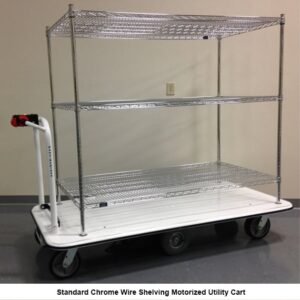
The utility cart ships in three deck lengths, all 25.5 inches wide and 35.5 inches tall, at 40 inches, 49 inches, or 61 inches long. Pick the deck by the footprint of what you move, not by the widest aisle you own. A 40 inch deck turns and parks in places a 61 inch deck cannot, and a deck longer than your load just adds length you have to thread through doorways. For mixed parts and totes the 49 inch deck is the usual middle choice. You can add shelving on top of the deck for light assembly and kitting work.
What makes the mailroom cart different?
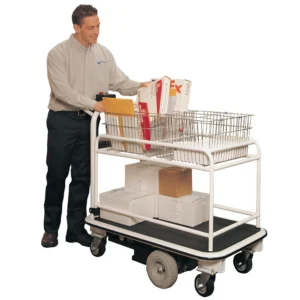
The 1031-SM01 Mailroom Cart is built for mail and parcel rounds rather than a flat platform load. It adds two welded steel baskets sized for mail trays and packages on top of the lower 1,500 lb deck, and it rides on a center-wheel drive with spring suspension so trays do not bounce across thresholds and elevator gaps. It runs the same 0 to 3 mph hi-low control as the utility cart, and an 8 hour runtime covers a full delivery shift. One thing to check before you buy. The mailroom cart carries a 2-year frame and motor warranty, not the 5-year term that covers the standard utility cart, so confirm the exact term that applies to your model.
How long does the battery last per charge?
The utility cart runs a full 8 hour shift on a charge and covers up to 10 miles of indoor travel per charge. It recharges in about 4 hours from a standard outlet through its onboard UL and cUL listed smart charger, which accepts 100 to 240 VAC. The mailroom cart also runs a full 8 hour shift and recharges from its own onboard UL and cUL listed smart charger, which runs on standard 120 or 240 VAC. Charge either cart overnight and it is ready at the start of the next shift, so most single-shift operations never see one run flat mid-route.
Are these carts made in the USA?
Yes. Both are built in the United States by EK Tech as part of the Pony Express line of commercial powered carts. EK Tech also backs the line with a 21-day demo program, so a facility can trial a unit on its own floor before committing.
When should I choose a tugger or a lift cart instead?
Choose a powered electric tugger when you need to tow several wheeled carts in a train behind one operator rather than carry a single load on a deck. Choose a powered scissor-lift cart when the job is raising a load to bench or conveyor height, not rolling it level. These utility and mailroom carts are the right tool when the work is moving a loaded deck or a parcel round across a building at floor level. We sell walk-behind, pedestrian-operated equipment only. We do not sell ride-on tow tractors, so if your moves are long enough to need one, those fall outside this line. See the full motorized carts range for warehouse and industrial models.