

 4.8
4.8How to Transport Oxygen Cylinders Safely in a Hospital
To transport oxygen cylinders safely in a hospital, secure each cylinder upright on a cart or rack so it cannot fall, slide or roll, keep the valve protected with its cap on until the cylinder is connected, and move at walking speed with the route clear. Almost every handling rule traces back to one idea. A charged medical oxygen cylinder holds gas at very high pressure, and the valve is the weak point.
The single biggest hazard is a knocked-off valve. If a cylinder tips and the valve shears against a hard surface, the escaping gas can drive the cylinder across a room like a missile. That is why a loose, unsecured cylinder is never acceptable in transit, and why three jobs sit underneath every safe method. Secure the cylinder upright. Protect the valve. Control the movement. A rack, a chain or a strap does the first two. Walking speed and a working brake do the third.
Last updated June 2026. Heavy Duty Mobility supplies the handling carts that move these cylinders. The exact requirements that bind your hospital come from the named standards below and from your own facility's written policy. Those standards spell out the rules in plain terms, and your facility has adopted a specific set to follow.
Our picks at a glance
- Top Pick
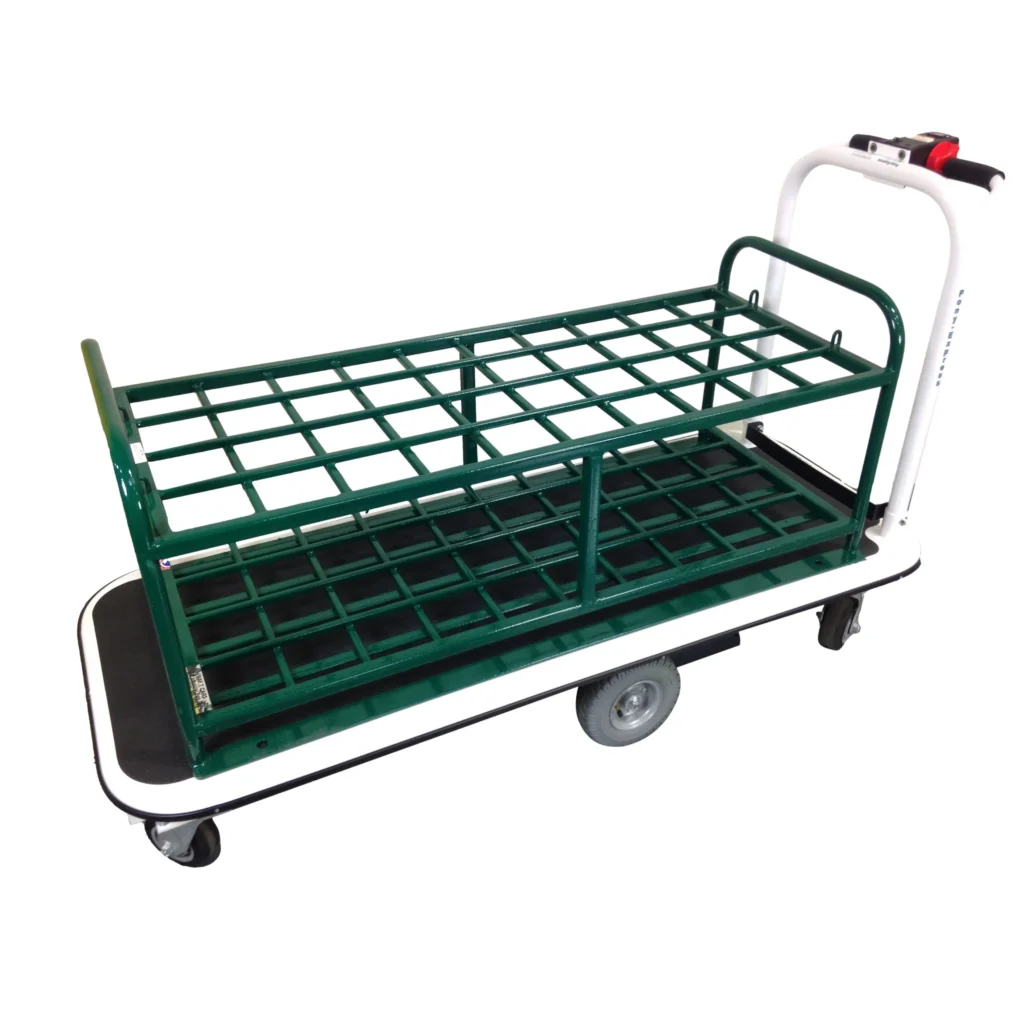
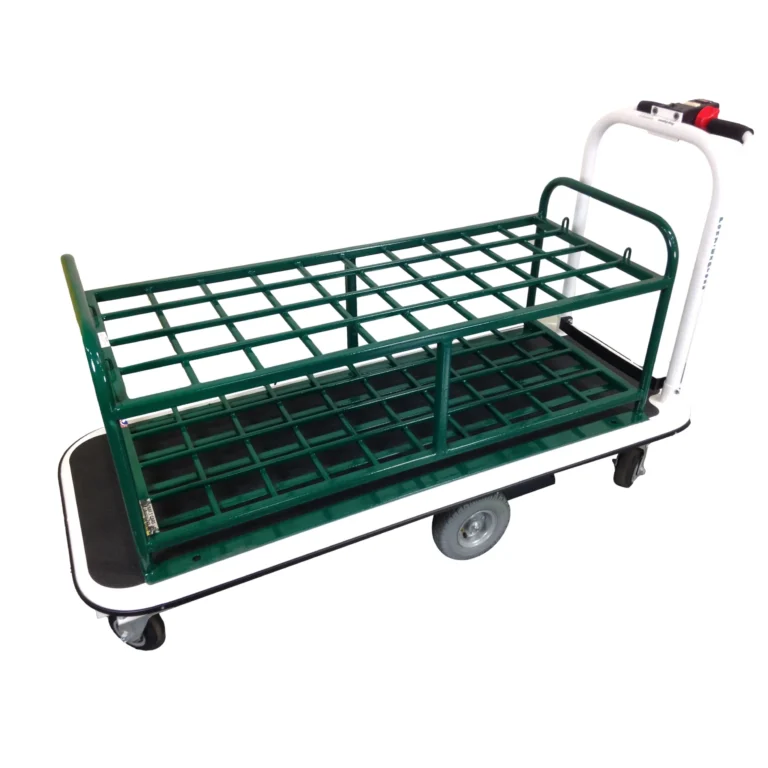 EK Tech Pony Express MGC Series Motorized Medical Gas Cylinder Cart
- Cylinder RacksRacks for 24, 32, 40, or 48 cylinders
- Accepted CylindersM7, M9, C, D, or E cylinders
- Weight CapacityStandard 1500 or 2000 lbs capacity decks, larger payloads available
$4,549View details and price
How do you transport oxygen cylinders safely in a hospital?
Transport oxygen cylinders in a hospital by securing each one upright in a cart or rack, with the valve protected and the cap on until use, restrained so it cannot fall, strike a surface or roll. Never carry a cylinder by its valve, never drag it, never roll it on its base, and never move a cylinder that is not held in place.
The reason the upright-and-restrained rule sits at the top is the pressure inside. A small medical oxygen cylinder can hold gas at roughly 2,000 pounds per square inch when full. The cylinder body is built to contain that. The valve sticking out of the top is not. Knock the valve off and the cylinder vents its entire contents through a small opening in seconds, which is enough thrust to launch it. Securing the cylinder so it cannot tip is the whole point of a rack or a cart.
Which rules govern moving compressed gas cylinders in healthcare facilities?
Moving compressed gas cylinders in a US healthcare facility falls under OSHA 29 CFR 1910.101 and 1910.253, NFPA 99 for medical gas systems, and CGA guidance such as Pamphlet P-1, with the hospital setting its own written policy on top. No single document is the whole answer. The binding requirement is whichever standard your facility has adopted into its environment-of-care program.
The federal general-requirements rule is 29 CFR 1910.101, which pulls the Compressed Gas Association's handling pamphlets in by reference. 29 CFR 1910.253 adds the rule that oxygen and fuel-gas cylinders be kept apart by distance or a fire-rated barrier in storage. NFPA 99 governs how a hospital stores and handles medical gases. CGA Pamphlet P-1 is the industry handling reference OSHA points back to, and The Joint Commission checks that the hospital enforces all of it through written policy and staff competency.
Read together they say the same thing. Keep cylinders upright and secured, protect the valve, segregate oxidizers from fuel gases, separate full from empty, and move them on equipment built for the job. The standards set the floor. Your facility policy is what staff are held to, and it can be stricter.
Is oxygen flammable or an oxidizer?
Oxygen does not burn on its own. It is an oxidizer, which means it makes other materials ignite more easily and burn faster and hotter. The danger is not that the oxygen catches fire, it is that anything flammable near a leaking cylinder burns far more violently in an oxygen-rich pocket of air. That is why oil and grease must never touch an oxygen valve, regulator or fitting, why combustibles stay off the cart and out of the path, and why segregation from fuel gases shows up in the storage rules.
Step by step - how to move an oxygen cylinder across a hospital
Move an oxygen cylinder by closing the valve and bleeding the regulator first, fitting the valve protection cap, inspecting the cylinder and cart, loading it upright into a secured rack, then transporting slowly with the route clear. Each step removes a specific hazard before the cylinder ever starts moving.
- 1. Close and bleedClose the cylinder valve and bleed regulator pressureNever disconnect a regulator under pressure
- 2. Cap the valveRefit the valve protection cap before movingThe valve is the most vulnerable part
- 3. InspectCheck cylinder, cart and brake for damage or leaksNo oil or grease on oxygen fittings
- 4. Secure uprightRestrain the cylinder upright by chain, strap or rackNever carry, drag or roll on the base
- 5. Move slowTransport at walking speed, watch ramps and thresholdsNever leave a cart unattended on an incline
- 6. Set, secure, connectSet the brake and secure the cylinder before connectingSeparate full from empty at storage
Close and bleed. Close the valve fully, then bleed the trapped pressure out of the regulator before disconnecting anything. Never break a connection still under pressure.
Cap the valve. On cylinders fitted for one, replace the valve protection cap before the cylinder moves. The cap takes the hit if the cylinder is knocked or dropped.
Inspect. Look the cylinder over for dents, corrosion or a hissing leak, check the cart for damage and a brake that actually holds, and confirm no oil or grease is on the fittings.
Secure upright. Load the cylinder upright and restrain it with a chain, strap or fitted rack so the body cannot fall and the valve cannot swing into anything. This is the non-negotiable one.
Move slow. Transport at walking speed with the load kept low and stable. Slow down for every ramp, door threshold and elevator gap, and never leave a loaded cart unattended on an incline.
Set, secure, connect. At the destination, set the brake and confirm the cylinder is still secured before connecting anything. Connection is the last step, never the first.
How do you secure medical gas cylinders for transport?
Secure medical gas cylinders by restraining each one upright with a chain, strap or fitted rack so the body and valve cannot move, then moving them on a wheeled cart rather than carrying or hand-trucking a loose bottle. Keep the protection cap on until the cylinder is connected, and remove or fully depressurize the regulator before a move so nothing fragile sticks out unguarded.
A purpose-built rack beats an improvised cart for one reason. The rack matches the cylinder. Medical gas cylinders come in a range of sizes, and an M7, M9, C, D or E cylinder each has its own diameter and height, so a rack sized for the bottle holds it snug where a generic cart lets it rattle or lean. There is a human cost the equipment addresses too. Lifting, pushing and dragging heavy bottles over distance is tied to back, shoulder and hand injuries among the staff who do it shift after shift. A wheeled cart removes the lift. A powered cart removes the push and pull on top of that. If you are buying for this, browse our powered medical gas cylinder carts and the wider range of motorized carts for hospitals and healthcare facilities.
How should you store and segregate cylinders at the destination?
Store cylinders upright and secured in a ventilated area, keep full and empty separated and labeled, keep oxygen away from fuel gases, and hold the separation distance from combustibles that NFPA 99 and OSHA 1910.253 set. Cite the code your facility adopted for the exact figure you put on a sign, not a vendor blog.
When does a powered medical gas cylinder cart make sense?
A powered medical gas cylinder cart makes sense when staff move full racks of cylinders over long hospital routes or up ramps, because the motor removes the manual push and pull forces behind the back, shoulder and hand injuries tied to manual cylinder handling. For a single cylinder over a short flat hop, a basic secured hand cart is fine. The powered cart earns its price when the load is heavy, the distance is real, or the route has a grade.
What a powered cart adds over a manual one is control. A motorized drive means nobody is straining against a loaded rack. An automatic holding brake parks the cart on a slope so it cannot roll when the operator stops, which is the exact moment a manual cart on a ramp turns dangerous. Variable speed keeps the move at a walking pace, and an emergency stop, horn and keyed power give an operator a way to halt the cart and keep it from wandering off when parked.
The powered cart built for in-hospital cylinder transport
- #1Best overall
EK Tech Pony Express Motorized Medical Gas Cylinder Cart
The one product in our catalog built specifically for safe in-hospital cylinder transport. Its racks hold and protect 24, 32, 40 or 48 cylinders and accept M7, M9, C, D or E bottles with a protective coating, so the cylinders ride secured and upright rather than rattling on a generic cart. The motorized center-wheel-drive base removes the manual push and pull forces tied to back, shoulder and hand injuries, and the regenerative and automatic holding brakes keep a loaded rack from rolling on a 6 degree incline.
See price & details- Pros
- Cylinder racks for 24, 32, 40 or 48 M7, M9, C, D or E cylinders with protective coating
- Standard 1500 or 2000 lbs capacity decks with larger payloads available
- 0-3 mph with High and Low speed control and up to 10 miles per charge
- Regenerative and automatic holding brake, horn, key switch and emergency stop on a 39 inch handle
- In stock and made in the USA
- Cons
- Overkill for moving a single cylinder a short flat hop, where a basic secured hand cart already does the job
- It is a handling aid only and does not by itself satisfy NFPA 99, OSHA 1910.101 or 1910.253 or your facility policy
- 24, 32, 40 or 48cylindersCylinders per rackAccepts M7, M9, C, D or E
- 1500 or 2000lbsDeck capacityLarger payloads available
- 0-3mphSpeedVariable High / Low control
- Up to 10milesRange per chargeOn-board smart charger
- 6degreesIncline ratingAutomatic holding brake
- 39inchesHandle heightHorn, key switch, emergency stop
The cart purpose-built for this job is the EK Tech Pony Express Motorized Medical Gas Cylinder Cart, product 38414. It is the one item in our catalog built specifically for safe in-hospital cylinder transport, priced at $4,549 and in stock. The racks come in four sizes, holding 24, 32, 40 or 48 cylinders, and accept M7, M9, C, D or E bottles with a protective coating that cuts noise and guards the cylinders in transit. Underneath, the powered base carries a standard 1,500 or 2,000 lb capacity deck, runs 0 to 3 mph, covers up to 10 miles on a charge, and climbs a 6 degree incline with regenerative braking and an automatic holding brake. Safety hardware sits on the 39 inch handle. A horn, a key switch and an emergency stop. The tires are non-marking for polished hospital floors.
How to size the rack to your cylinder mix and route
The rack size is the first decision, and it is the one people get wrong most often. The four options, 24, 32, 40 and 48 cylinders, are not just about how many bottles fit. A bigger rack tempts staff to move more at once, which raises the loaded weight that has to go up the ramp and around the corner. The right size is the number a single operator actually moves in one trip on your busiest route, not the maximum the cart can hold.
Raphael's rule of thumb Count the cylinders that leave central supply on one trip during a normal shift, not the count on the worst day. Size the rack to that number and let the second trip handle the surge. A 48-cylinder rack that goes out half full most days is a cart that is harder to steer and heavier on the brake for no daily benefit. I would rather see a department on a 24 or 32 that runs twice than a 48 that gets parked because it feels unwieldy.
Route shape decides the rest. The incline rating matters more than top speed inside a building, because the dangerous moment is a loaded rack stopped on a ramp, not a cart at full pace down a straight corridor. The 6 degree rating and the automatic holding brake are what let an operator stop on a grade and walk away without the cart creeping. If your route is flat and short, a manual secured cart covers it. If it has a ramp, an elevator threshold, or a long basement-to-ward run, the powered base is where the injury math turns. Non-marking tires and the noise-damping rack coating are not cosmetic on a night shift, when a rattling rack of bottles wakes a ward.
Cylinder cart vs flat-deck powered cart - which do hospitals need?
Hospitals that move racked cylinders need the dedicated cylinder cart with rack restraint. Those moving mixed flat loads can use the same EK Tech powered base as a flat-deck platform cart. The choice comes down to whether the cargo is cylinders that must be secured and protected or general goods on a deck.
The cylinder cart, product 38414, holds and protects cylinders in fitted racks, which is the right pick whenever the load is oxygen or other medical gas bottles. The Pony Express 1031 motorized platform cart, product 38296, shares the same powered center-wheel-drive base but carries a flat deck instead of cylinder racks, so it suits mixed flat loads rather than bottles. The 1031 carries 1,500 to 2,000 lbs across its sub-models on an 11.5 inch deck that scales from 25.5 or 34.5 inches wide by 40 to 61 inches long, runs a variable 0 to 1.5 mph on low and 0 to 3.0 mph on high, and pairs regenerative and automatic holding brakes with an electromagnetic parking brake. Its 35 Ah AGM battery is rated for 8 hours of operation. Its incline figure is not published, so the table below leaves that cell as not specified rather than inventing one. It is priced at $3,295.
The point of the shared base is that a facility standardizes on one drive system and swaps the top. The same controls, the same brake behavior, the same charging routine, whether the operator is moving a rack of E cylinders or a deck of supplies. That is the practical reason to keep both carts in the same EK Tech family rather than buying a cylinder cart from one maker and a platform cart from another. Staff learn one cart.
EK Tech powered cart spec comparison - dedicated cylinder cart vs 1031 flat-deck base
| Cart | Weight Capacity | Speed | Incline Rating | Cylinder Racks / Deck | Braking |
|---|---|---|---|---|---|
| EK Tech Pony Express Motorized Medical Gas Cylinder Cart | Standard 1500 or 2000 lbs capacity decks, larger payloads available | 0-3 mph | 6° | Racks for 24, 32, 40, or 48 cylinders - accepts M7, M9, C, D, or E cylinders | Regenerative braking and automatic holding brake |
| Pony Express 1031 Motorized Platform Cart (up to 2,000 lbs) | 1,500 to 2,000 lbs (per model) | 0 to 1.5 mph low setting, 0-3.0 mph high setting | Not specified | Flat deck 11.5" deck height, 25.5" or 34.5" wide x 40" to 61" long (per model) | Regenerative braking with automatic holding brake, electromagnetic parking brake |
The same line covers more hospital jobs without changing the drive base. The Pony Express Motorized Linen Cart handles bulk linen, and the 1031-SM01 Mailroom Cart moves internal mail and small parcels. For facilities that already own wheeled cylinder trolleys, the Pony Express 1061-HD Electric Powered Tugger tows them behind a hitch rather than carrying them on a deck, which is the right tool when you are moving carts you already have rather than buying new racks. If you are still deciding on deck size and load, our guide to how to spec a motorized platform cart by load and deck size works through the platform ladder, and our guide to choosing the right battery for a powered hospital cart covers runtime and charging so the cart lasts a full shift.
One guardrail matters here, because this is a safety topic. A powered cart is a handling aid. It does not, by itself, satisfy NFPA 99, OSHA 1910.101 or 1910.253, or your facility policy. Buying the cart does not check a compliance box. Staff still close and cap valves, secure each cylinder, segregate gases and follow the named codes and the facility's written program. The cart makes the safe method easier to follow, which is its real value rather than a substitute for the method.
Raphael's rule of thumb If two people are tag-teaming a loaded cylinder rack down a corridor because one cannot hold it on the ramp alone, you have already justified a powered cart. The injury you are pricing against is not the dramatic dropped-cylinder story, it is the slow accumulation of back and shoulder strain on the porter who moves that rack twenty times a shift. A motorized base pays for itself in the claims you never file.
Frequently asked questions
Can you transport an oxygen cylinder lying down?
No. Transport medical oxygen cylinders upright and secured, not lying down. A cylinder on its side can roll, slide off a cart and let the valve strike a hard surface, and a sheared valve turns a high-pressure cylinder into an uncontrolled projectile. Stand each cylinder up and restrain it with a chain, strap or fitted rack so the body and valve cannot move. The upright-and-secured rule runs through OSHA 1910.101, NFPA 99 and CGA P-1, and your facility policy will say the same. The only safe horizontal position is none during routine in-hospital transport.
Do you need to put the valve cap on before moving an oxygen cylinder?
Yes, on any cylinder fitted for a valve protection cap, replace the cap before the cylinder moves. The cap protects the valve, which is the most vulnerable part of the assembly and the one that turns a dropped cylinder into an emergency if it shears. Before fitting the cap, close the cylinder valve and bleed the pressure out of the regulator so you are never disconnecting under load. Then cap the valve, load the cylinder upright into a secured rack, and move. A capped cylinder that tips is a manageable problem. An uncapped one is not.
How far apart must oxygen and fuel gas cylinders be kept?
Oxygen is an oxidizer and must be segregated from flammable and fuel gases in storage, kept apart by a set distance or a fire-rated barrier rather than stored side by side. The exact separation distance is the figure in the standard your facility has adopted, drawn from OSHA 29 CFR 1910.253 and NFPA 99, so cite the code your hospital follows for the number you put on a sign or label rather than a vendor figure. The principle holds everywhere. Keep oxygen away from fuel gases, away from heat and ignition sources, and away from combustibles such as paper and linens.
Is oxygen flammable?
No, oxygen does not burn on its own. It is an oxidizer, which means it makes other materials ignite more easily and burn faster and hotter. That is why oil and grease must never touch an oxygen valve, regulator or fitting, since petroleum products can ignite on contact with high-pressure oxygen with no spark. During transport, keep cylinders away from open flame, heat and ignition sources, hold to a no-smoking rule along the cart route, and keep combustibles off the cart and out of the path. The hazard is not the oxygen catching fire, it is everything flammable nearby burning far more violently in an oxygen-rich pocket.
Who can move medical gas cylinders in a hospital?
Trained, competent staff who follow the facility's written handling policy move medical gas cylinders, which in practice means porters, respiratory therapists, nurses and facilities techs the hospital has trained and signed off. The named standards do not list job titles. They set the handling requirements, and The Joint Commission's Environment of Care standards expect the hospital to enforce those through written policy and documented staff competency. So the real answer is whoever your facility has trained and authorized for the task, following the procedure, not whoever happens to be nearest the cylinder.
What is the safest way to move a full rack of oxygen cylinders?
The safest way to move a full rack of oxygen cylinders over distance or a ramp is a powered cylinder cart that secures each bottle upright and carries the load under motor power, so nobody strains against the rack and an automatic holding brake parks it on a slope. The EK Tech Pony Express Motorized Medical Gas Cylinder Cart carries racks for 24, 32, 40 or 48 M7, M9, C, D or E cylinders, runs 0-3 mph with an automatic holding brake on a 6 degree incline, and lists at $4,549 in stock. A powered cart is a handling aid, not a compliance shortcut. Staff still cap valves, secure each cylinder and follow the named codes and facility policy.
These handling rules come from federal regulation, the medical-gas code, the compressed-gas industry handling reference and the accreditor that checks enforcement. Every product number traces to a manufacturer spec sheet. The full list is below.
Sources & references
- OSHA 29 CFR 1910.101 - Compressed gases (general requirements) Authority
- OSHA 29 CFR 1910.253 - Oxygen-fuel gas welding and cutting (storage and separation) Authority
- NFPA 99 - Health Care Facilities Code (medical gas storage and handling) Authority
- Compressed Gas Association - CGA P-1 Safe Handling of Compressed Gases in Containers Authority
- The Joint Commission - Environment of Care standards Authority
- EK Tech Pony Express Motorized Medical Gas Cylinder Cart - specifications (manufacturer, product 38414)
- Pony Express 1031 Motorized Platform Carts - specifications (manufacturer, product 38296)